

Summary: Billionaires buy newspapers now. It is a whole genre. Jeff Bezos bought the Washington Post, David Ellison bought CBS, and when it happens, serious people in those cities spend years watching the owner’s hand. Last week the genre arrived in Yountville, at 1/500th the scale and none of the scrutiny. An Orange County billionaire who owns 22 acres of the town’s center, and who cannot vote here, backed a petition drive that used barely 10 percent of the registered voters to overturn zoning for more than 100 workforce housing units on public land. Then he bought the only newspaper, 103 days before an election for three of five council seats. The paper announced it with a profile of him, written by his employee, about how much he loves the town. Yountville is being asked to find this heartwarming. This essay would like to interrupt.
The Puff Piece
On July 23 the Yountville Sun broke the biggest local story of the year, which was who owns the Yountville Sun. It handled the scoop the way any hard-nosed newsroom would. It assigned the story to an employee of the new owner, who interviewed the new owner about his feelings.
We learned that he has been visiting the valley for 40 years. We learned that he considers himself a steward. We learned that when The Estate Yountville landed on his desk he had no idea it was, in his words, essentially half the town, which is the real estate equivalent of accidentally adopting a horse. We learned that he had always admired the Sun as a voice of reason, and we learned precisely when the voice had been most reasonable, which was during the debate over the Commons, the workforce housing he spent last winter working to stop.
We did not learn the price. We did not learn the seller. We did not learn who can fire the editor. Under a heading assuring readers that editorial independence remains, the paper reported the owner’s assurance that it does. This is like a heading that says “The Fox Comments on Henhouse Security.”
When Bezos bought the Post, the Post’s own reporters covered the sale as news and spent the next decade publicly wrestling with what it meant. When Ellison took CBS, half the country’s media writers stood watch. That is the custom when a rich man buys an instrument that tells a community what is true. Yountville got a feature about stewardship, and the town’s reaction so far has been somewhere between a shrug and a thank-you note.
Washington can watch Bezos because Washington has other newspapers. The Sun is the only newspaper Yountville has.
The Inventory
Step back and count what one man now holds in a nine-block town of 2,900 people.
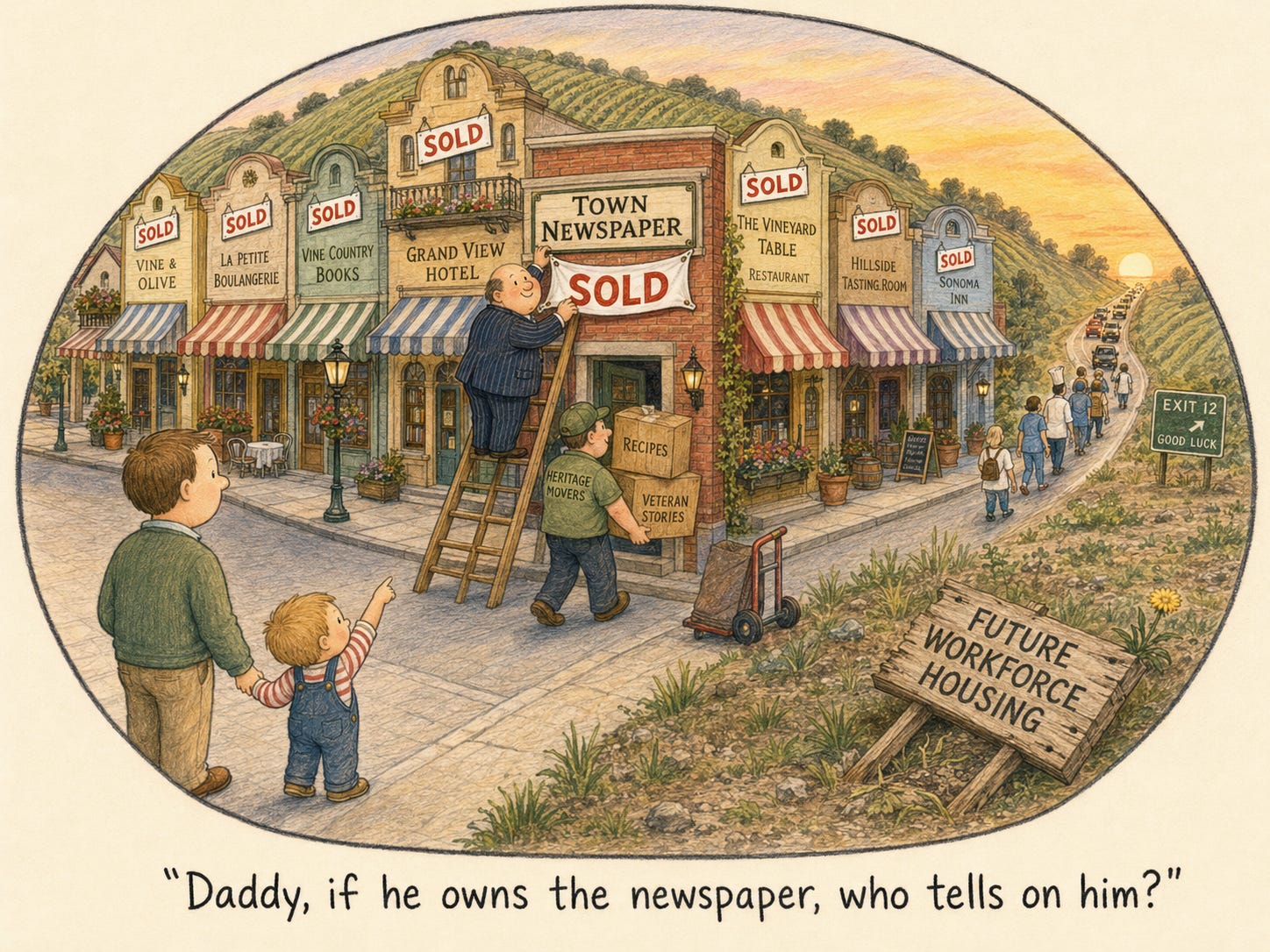
The largest commercial property, 22 acres in the center, bought for a figure reported near $300 million. The second property down the street. And as of July, the newspaper, the thing that decides which of the town’s arguments the town gets to hear.
Now count what is in play in the next 14 weeks. A mayor’s seat and two council seats, three of five, on the November 3 ballot. The town manager’s office, vacant since spring, the job that runs the planning department and controls what the council sees before it votes. And already, on the very day the Sun announced its owner, its letters page carried an argument that the manager hire should wait for the next council. A delay like that has value only to someone expecting the next council to be different from this one.
None of this is a crime. All of it is a pattern, and the pattern has a name. It is what acquiring a town looks like when the town is small enough to acquire.
The Empty Chair Where the Ideas Go
Here is the part that should bother you more than the money.
Be precise about what happened, because the precision is the story. He is not against housing. Nobody with 22 acres of hotels objects to construction as a concept. What was overturned was zoning, adopted by the elected council, that would have allowed more than 100 workforce housing units, deed-restricted, on public land, paid for by a tax his guests remit. It was suspended by a petition carrying the signatures of barely 10 percent of the town’s registered voters, and no election was ever held. Understand what that project would have cost him. Nothing. Not a dollar, not a foot of his property, not a room off his inventory. The town had the land, the money, and the votes, and the project could have been built without asking him for anything at all. That is the zoning he spent three months helping to overturn.
And in all those months, through the records requests, the outside counsel, the council appearances, and the letters calling the elected government hubristic and amateur, neither he nor anyone speaking for him has offered one single idea for housing the workforce. Not a site. Not a unit count. Not a dollar. Not a plan. Months of lawyers and public record requests, and the sum total of the counteroffer is nothing.
Almost nothing. His firm did submit one document. A drive time analysis, presented with two of the town’s other large operators, arguing that workforce housing was unnecessary because the workers can drive. Its own table counts 757 employees, of whom 39 live in Yountville. The other 718 commute from Napa, Vallejo, American Canyon, Fairfield, and points beyond, and the study presents this, with a yellow highlight, as the good news. So there is the one idea, the only one on file so far. Let the poor folk commute.
The Suck-Up
Which brings us to his plans for the newspaper, announced in the same profile. He would like a Veterans Spotlight, honoring the residents of the Veterans Home. He would like a Chef’s Corner, with recipes from the town’s kitchens.
Consider the nerve involved. The State of California reported, before this fight ever began, that the Veterans Home cannot fill nursing shifts because caregivers cannot afford to live within reach of it. The kitchens run the same way, on the 718 commuters counted in his own firm’s spreadsheet. The town was fixing it, with its own land, its own money, and a 72 percent voter mandate. He showed up and stopped it. It would have cost him nothing, no journalist has ever asked him why, and he has never offered a plan of his own. Now his first act as a publisher is to ask those same nurses and cooks for their stories and recipes. He would not give them a home in this town. But he might write a cute story about them in his newspaper.
It is a ham-fisted play and an old one. You do not have to house people you can feature. A spotlight is free. The recipes are free. The apartments were the expensive part, and the expensive part was postponed until after the election, and now comes the content.
The veterans, for the record, are roughly 540 residents of this town, a population more than twice the size of the petition that repealed zoning ordinance to create more workforce housing. Perhaps the Spotlight is pure generosity. Perhaps it is aimed at the one population in Yountville big enough to swing an election, launching 103 days before one. Readers can decide, once they know both facts, which is the reason this publication prints both facts.
LOL
The people of Washington did not simply trust Bezos. The people watching CBS do not simply trust Ellison. Those owners are at least media operators with reputations staked partly on the product. Yountville is being asked to extend more trust than that, on less evidence, to a hotel owner from Orange County who told his own paper that its value to him was its performance during his political fight.
The residents of this town are not being asked to hate anyone. They are being asked to stay awake for 14 weeks. Read the Sun, enjoy the recipes, and every time a story frames the election, ask the only two questions that matter. Who owns this? What does he want?
He has told you the second answer himself, by what he helped overturn and what he bought and what he has never once proposed. The land is still public. The money is still in the account. Three of five seats are on the ballot. Nomination papers close August 7. The 718 people in the spreadsheet cannot vote here. You can.
Next in this series: the Veterans Home itself. It is the oldest institution in Yountville, the largest, and the least understood by the people who live a few blocks from its gate, and the questions that matter, how many veterans live there, why its beds are going unfilled, and what this town owes the institution that built it, deserve more than a spotlight. Facts and Fantasy Around the Veterans Home, reported from the Home and the public record, arrives next week. ☾
Brendan Kelly
Sources: Yountville Sun, July 23, 2026; Yountville Hospitality and Restaurant Workforce Drive Time Analysis, Boardwalk Investments Group; Veterans Home of California-Yountville Master Plan of 2022, CalVet.
Disclosure: The author served for approximately two years as Owner’s Design Consultant on the Yountville Commons project, a role that concluded before this publication began. He writes as a private citizen
.