


Summary: In 2018, Yountville voted overwhelmingly to tax hotel guests for workforce housing before the Town owned any land to build it on. The land came later, when the elementary school closed and the Town used more than $3 million of that revenue to help buy the site for exactly that purpose. Eight years after the vote, 235 petition signatures stopped the Town from finishing what the public had already paid for. What is contested now is whether the assets the voters bought stay under public control and deliver the housing they were promised, or fall under the control of private interests one delay at a time.
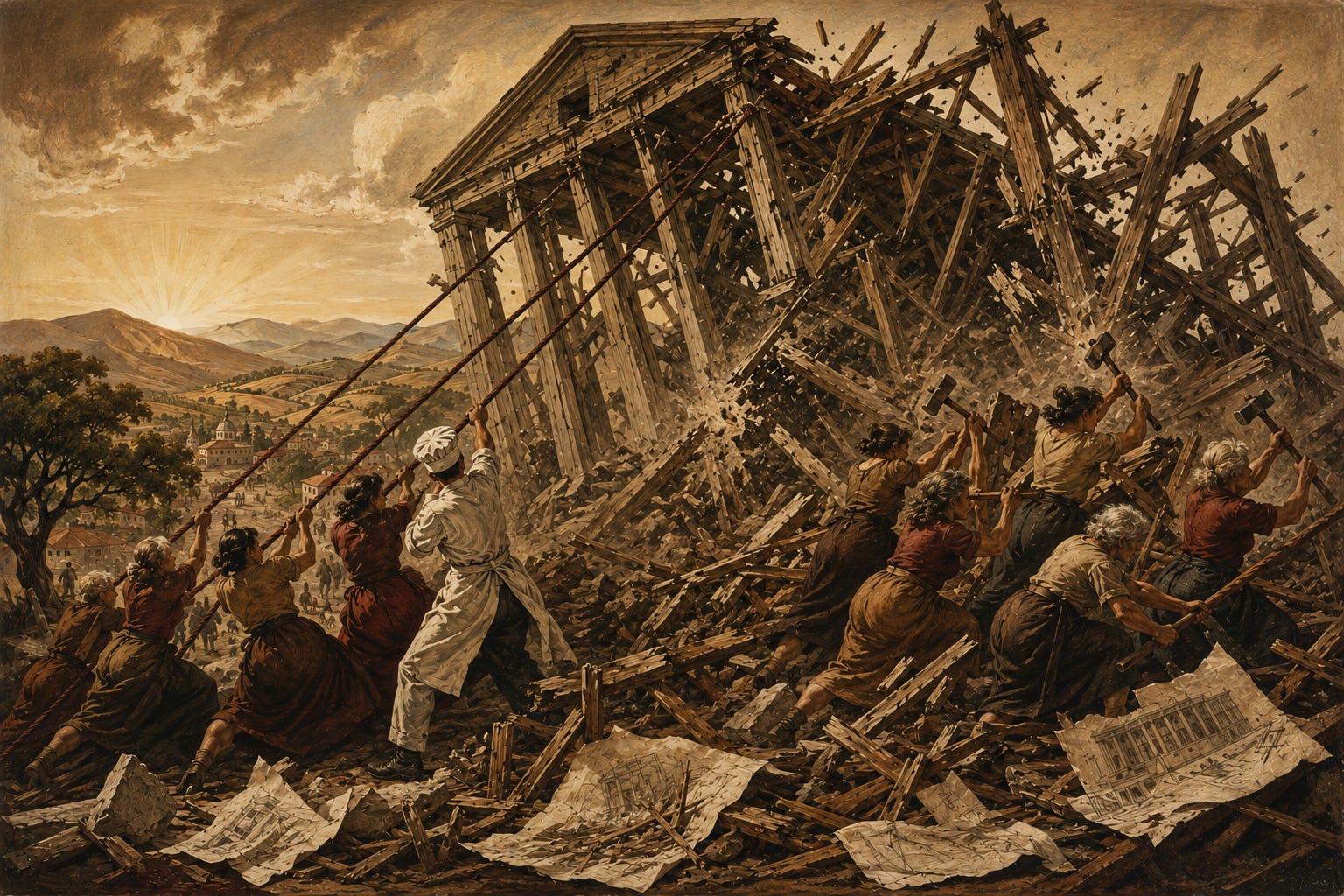
In a town as small as Yountville, power rarely arrives under its own name. It arrives as concern about process, unease about scale, nostalgia for a vanished place, or a worry about unit mix. The people advancing an interest call it common sense. The people gathering influence call themselves neighbors. By the time anyone admits that a political contest is underway, the most important part of the contest may already be over.
That is the setting in which the Yountville Commons was stopped last winter. The Town Council had approved the ordinance and tentative map by a vote of four to one after years of public meetings, planning, environmental review, infrastructure work, design studies, financial analysis and repeated revisions. The property was not privately owned land awaiting an applicant. It was the former elementary school, closed by declining enrollment and purchased by the Town in part with more than $3 million of Measure S revenue, then reopened to the public after years behind fences. The Commons was meant to become the center of civic life again, with housing occupying roughly one-quarter of the site and more than half remaining open space.
The people of Yountville never voted to reject that plan. Two hundred thirty-five registered voters signed a petition during the brief period allowed by state law. That was enough to suspend the ordinance and require the Council either to repeal it or send it to an election. The Council repealed the ordinance rather than hold the entire project in place through another campaign, another construction season and another period of mounting public expense.
The repeal has since been described as though it were a town-wide verdict. It was nothing of the kind. It did not restore the school, preserve the property as permanent open space or establish a different plan for the site. It did not reduce the Town’s housing obligations or replace the approvals that had just been removed. It did not show that the people who opposed the Commons agreed about what should happen next. It stopped one public process at the moment when that process was finally approaching the point where its costs, phases and first construction decisions could be tested in the market.
A Mandate Taken Seriously
The public vote that mattered had already taken place eight years earlier. In 2018, Yountville voters approved Measure S by nearly three to one. The measure directed revenue paid by visitors toward affordable and workforce housing. More than one thousand voters said yes. Roughly one-quarter of those voting said no. The remarkable part of the vote is often forgotten. The Town owned no land to build on when the measure passed. Voters taxed their visitors on the strength of a possibility, trusting that a site would eventually exist. When declining enrollment closed the elementary school, the possibility became a place, and the Town spent the money as instructed.
The site was never imagined as housing alone. The Town removed the fences, made immediate improvements and returned the property to public use. The name Commons was chosen deliberately. It described a place that belonged to the town and would be shaped through public decisions. Housing was one part of a larger civic landscape that included community buildings, gardens, open space, public paths and the repair of a physical center that had gone quiet when the school closed.
An Entitlement Is an Asset
The Council’s task was not to authorize the construction of every building shown in a long-range plan. It was to create the legal and physical framework that would allow the Town to make responsible construction decisions later. The property had to be zoned. A tentative map had to establish the pattern of parcels, utilities and access. Possible unit mixes had to be studied. Phasing alternatives had to be drawn with enough specificity that qualified design-build teams could price the work. Without those steps, the Town could not obtain true competitive pricing for a first phase or determine what Measure S revenue, rental income and public financing could prudently support.
The ordinance was therefore a beginning, not a blank check. The tentative map did not commit the Town to an entire buildout. The drawings did not obligate the public to spend the total cost of every possible phase. They created a platform from which the Town could ask the questions that opponents now say were never answered. The number of units in the first phase, the bedroom mix, the construction cost, the borrowing capacity, the rent structure and the sequence of public improvements could only be resolved after the zoning and map made the project real enough to bid.
The petition stopped that work before the prices arrived.
The people associated with stopping it now speak often about wasted public money. The accusation depends on forgetting what the money was purchasing. Planning, environmental review, infrastructure design, zoning, mapping and procurement documents are not decorative exercises. They convert an uncertain property into an entitled asset. They make financing possible. They allow builders to compete on a defined scope. They give future councils choices that can be exercised without starting again from the beginning.
The petition stripped away the approvals that gave much of that work its value, then used the absence of a completed project as evidence that the work had been wasteful. The sequence is important. The Town did not spend money and fail to act. It spent money in order to act, reached the point where action could be priced, and was stopped by a petition signed by 235 voters. The interruption was later offered as proof that the interrupted process had gone nowhere.
The Model Was the Threat
The Commons was designed to do something California towns are routinely told they cannot do. The Town would build workforce housing itself, in small phases, on its own land, on its own schedule. No master developer would take title. No private partner would control the pace. The Town would price a first phase through competitive design-build procurement, build what the numbers supported, and then decide, with the first buildings occupied and producing rent, whether and when to build the next. Each phase would be small enough to finance conservatively and stop cleanly, and each would teach the Town what the next one should cost. The approach traded speed for control, and control was the point.
The premise underneath the design was that workforce housing has become civic infrastructure. A town maintains streets, water and sewers because the place does not function without them, and no one asks the water system to justify itself against the possibility that a neighbor might someday share a well. Housing for the people who operate the town now belongs in that category, with one difference that separates it from every other public system. Streets and pipes only cost money. Housing, once its debt declines, returns it. A Town-owned portfolio would eventually generate rental income under public control, revenue that could maintain the buildings, extend the housing and reduce the town’s dependence on any private party’s willingness to act.
That is what made the Commons a threat to anyone committed to indefinite delay. The danger was not the density, which was modest, and not the cost, which had not yet been priced. The danger was the demonstration. A town that builds its first phase on its own land, watches the units fill with its own workforce and banks the rent has proven a method. The method is repeatable, and it requires no one’s permission. Every argument that housing must wait for the right private partner, the right neighboring landowner or the right decade collapses on the day the first phase opens.
The consequences of preventing that demonstration do not end at the edge of the former school grounds. Yountville’s current housing allocation is 72 homes through 2031, including 19 for very-low-income households. At this month’s Council housing session, Town staff counted 29 units permitted or approved, projected roughly 44 by the end of the cycle, and concluded that Yountville is not on pace to meet its obligations, particularly for very-low-income homes. The town has 1,372 existing housing units. About 100 carry deed restrictions for moderate-, low- or very-low-income households, and only 13 serve very-low-income residents. Roughly 20 percent of that protected stock could lose its restrictions within the next decade, with the first expirations beginning at the Mount Avenue Cottages in February 2027.
The workers described by these income categories are not abstractions created by state housing law. They are the people who make the town function every day. Hotel housekeepers, caregivers, retail employees, tasting-room workers, farmworkers and laborers fall within the very-low-income range. Hospitality managers and wastewater operators fall within the low-income range. Nurses, firefighters and some Town supervisors fall within the moderate-income range. Yountville’s prosperity depends on these workers, but its housing market largely excludes them. Workers arrive from other towns in the morning, maintain the hotels, serve the meals, care for residents, operate public systems and leave again at night. The cost of Yountville’s housing shortage is exported to highways, neighboring communities and households that surrender hours of each day to commuting.
Housing Delayed is Housing Denied
Delay is especially useful in housing politics because it can be presented as prudence. The opponent does not need to oppose affordable housing openly. Support can always be offered for a better project, a smaller project, a cheaper project, a different site, a later phase or another study. The perfect proposal remains safely in the future while the imperfect proposal in front of the public is stopped.
Delay has a second advantage. It requires nothing. The opponent of a specific project never has to produce a plan that pencils, a site that exists or a partner who has agreed to anything. It is enough to keep possibilities in circulation. At this month’s housing session, a former mayor rose during public comment to encourage the Town to continue discussions with the Veterans Home of California about workforce housing on state-owned land. The suggestion may be sincere. Its record is what matters. The Veterans Home is adjacent, state-owned and perpetually discussable, and years of conversation with it have never produced a single unit of housing the Town controls. In the meantime, the interim Town Manager told the Council that Yountville is running out of sites. The statement was accurate as far as it went. It was delivered in a chamber that stands a short walk from 7.5 acres the public already owns, bought with housing money for housing, zoned for housing once already, and stopped by 235 signatures.
For the worker who still cannot live in Yountville, the distinction between delay and rejection disappears. Construction costs continue rising. Financing assumptions expire. Consultants leave. Political coalitions change. The site becomes harder to discuss and more expensive to reconsider. A future Council begins again with another process, another study and another promise that the next plan will be handled more carefully.
This is how housing is defeated without anyone admitting to opposing housing.
The Town’s official Housing Element makes the fragility of the alternatives unusually clear. It identifies six opportunity sites with a combined realistic capacity of 93 units, but 88 of those units depend on two privately controlled properties, 16 assigned to a private garden parcel and 72 to the Catholic Church site. The remaining four sites together represent five units. A site listed in a Housing Element is not a construction commitment. It remains dependent on the owner, the market, financing and future politics. The Commons was different because the Town owned the land and had already advanced the approvals necessary to proceed.
The 235 petition signers did not create a more affordable plan, a smaller first phase or a better housing site. They stopped the discussions that might have produced those outcomes. They did not preserve the Town’s investment. They tore away the legal framework that made the investment useful. They did not solve the cost question. They prevented the public procurement process from producing the most reliable answer available.
The coalition now presents itself as the custodian of what remains.
Who Governs What Comes Next
The alliance that stopped the Commons contained residents with very different expectations. Many believed they were protecting the former school grounds from development. They feared the loss of open space, remembered the school as part of the town’s identity or distrusted the scale of what they had been told was coming. Their concern was sincere, even when it rested on the false impression that housing covered most of the property or that approval meant the entire long-range plan would be built at once. Other participants had different interests. Some large property owners and business figures may favor more development, provided it occurs on private land, produces private value and is considered by a Council more receptive to negotiated flexibility. They did not need to share the preservationists’ goals. They needed only to share their opposition to the public plan.
The petition allowed those interests to remain concealed within a single act. It asked what people wanted stopped and required no account of what they wanted instead. A resident hoping for less development could stand beside a property owner hoping for more intensive private development without either confronting the contradiction. The disagreement could be postponed until after the ordinance was gone and, perhaps, until after a new Council majority had been elected.
The modern company town is not built by purchase. It is built by control. No one from the petition campaign has proposed selling the school site, and no one needs to. The transfer happens differently. Public land sits idle while the Town holds serious conversations about land it will never govern. Measure S revenue accumulates while proposals circulate to route it through private partnerships that would own what it builds. Deed restrictions expire on schedule while the search for a perfect site continues. Control of the public’s assets passes to private interests not through a transaction but through a calendar. Nothing is ever sold. Everything is merely postponed, until the postponement becomes the policy.
This series is called The Town of Yountville Is Not for Sale because the struggle is no longer confined to the Commons. It concerns whether assets the public bought remain instruments of public purpose, whether elected government keeps the independence to use them, and whether a town whose economy creates extraordinary wealth will keep exporting the people who create it. The title is not an argument against business. Yountville depends on hotels, restaurants, wineries, shops and visitors, and they deserve a voice in public life. But economic importance does not confer greater civic authority. A payroll is not a constituency. Tax revenue is not a vote. The owner of a large property is still one participant in a public process governed by rules that must apply to everyone.
The Commons brought all of this into view. It joined public land, workforce housing, employer influence, private development interests, direct democracy and a Council election on one 7.5-acre site. The petition did not settle those issues. It suspended the one public framework that had begun to organize them.
The essays that follow will examine how 235 signatures acquired the appearance of a public mandate, how the language of preservation can serve private development interests, why the Town’s incremental building model threatened the politics of delay, what Yountville’s housing obligations now require and what every candidate should disclose before asking voters for control of the Council.
In 2018, more than one thousand Yountville voters directed the Town to use visitor revenue for affordable and workforce housing before a buildable site existed. The Council took that vote seriously enough to acquire land when the school closed, preserve most of it as open space, imagine a new civic center and bring a first housing phase close enough to reality that competitive pricing could begin. Two hundred thirty-five petition signers stopped the process before the answers arrived. The people responsible now point to the unanswered questions as evidence of failure and offer themselves as the better stewards of the town. The record has not disappeared. It has simply been obscured by repetition, grievance and the convenient fiction that repeal settled anything.
This series intends to bring that record into the light.