


Summary: A private developer could have built housing on the former elementary school, and one still might. The harder question was why the Town would surrender control of a public asset before the public had decided what it was for. After buying the seven-acre site in the spring of 2024 for roughly eleven million dollars, taking down the fence, and reopening the grounds, the Town spent two years on workshops, environmental review, and an approved site plan. It never set out to do the building itself. It planned to use public design-build, the method that delivered the Town Hall retrofit, hiring one team to finish the design and construct the first phase against the goals the community had set. Public ownership kept the rising value and the eventual rents with the Town and left affordability as a choice rather than a contract set to expire. A referendum later repealed the zoning, but it could not repeal the work or the fact that the Town still owns the ground.
A private developer could certainly have built housing on the site. And it’s possible one still may. But the Commons was never only a housing project. It involved public land, public pathways, open space, community-serving amenities, and a long-term question about who would control the site’s value once the work was done. Before the Town could bring in private building expertise, it had to answer a more basic question: why would it surrender control of a public asset before the public had decided what it was for?
The former elementary school sits near the center of Yountville, where it has stood for more than 125 years, and for most of that time, no one had much reason to think about who controlled it. Children walked to it. The school district owned the ground and ran the buildings and fields, and the rest of the town was slowly built around it. When the school closed, and the Town bought the site in the spring of 2024 for roughly eleven million dollars, that long, quiet arrangement ended. The first thing the Town did was take down the fence, make some long-deferred repairs and renovations, and let people back onto the grounds. The second thing was to ask residents what to do with the most important piece of public land inside its boundaries.
One question came up early, in workshops and in letters, and eventually from the dais. Why didn’t the Town just hire a developer? The question carried an assumption worth taking seriously. Developers raise the money, carry the risk, and coordinate the dozens of trades that turn drawings into a finished building, and a small town has none of that machinery standing ready. To a few residents, it seemed plain that the work of building a civic asset that included housing belonged to companies that build housing, and that the Town was reaching well outside its competence.
The Town never set out to do the building itself. By the time the Commons entitlements were approved, it was already moving toward the arrangement private developers use when a job grows from design intent to actual construction, which is to select a single team to complete the design and construct the first phase. Outside expertise was always going to be involved. The real question was narrower, and it had to do with who would set the goals before that expertise arrived.
Before any of that, the Town did the slow work. It spent two years acquiring the site, opening it to the public, renovating several of the buildings for public use, holding workshops, weighing alternatives, completing environmental review, and arriving at a site plan that moved through 23 public meetings to Town Council approval. What remained was implementation, and the method the Town expected to use has a name most people have never needed to learn.
Public Design-Build is common in California, and most residents have benefited from it without hearing the term. School districts, counties, universities, and the Town of Yountville have all used it. Under the older approach, an agency hires an architect to draw a complete set of plans and then bids those plans out to a builder as a separate step, so design and construction stay in different hands. Design-build folds the two together. The town documents what it wants, and one team of architects, engineers, and builders takes responsibility for finishing the design and delivering the finished work for a fixed price.
What the town defines as success is the part that matters most: a budget ceiling, performance and sustainability standards, a schedule, and whatever else the community cares about. Teams compete to show how they would meet those terms, and the chosen team owns the route while the town keeps the destination.
The clearest local example is Yountville’s own Town Hall. When the building needed a seismic retrofit, the Town did not commission a full set of drawings and hand them to the lowest bidder. It wrote down what the work had to accomplish, a structure brought up to current code, to a set budget and schedule, and it chose one team to both design the retrofit and build it. The Council approved the criteria and approved the team. The building people walk into today is the result, and almost no one gives a thought to how it was delivered, which is the surest sign the method worked.
The Town reached the starting line for relatively little money. Its own accounting, laid out by category in the staff report for the June 16 Council meeting and its four public expenditure attachments, shows exactly where that money went. The land was the overwhelming share, roughly eleven million dollars, about 77 percent of everything spent. Repairing and reopening the buildings and grounds for community use, the gym and the farmstand, Schmitt Hall and the dog park, and the garden, came to about $1.6 million, work a private developer would never have done at all. Carrying the site through design, environmental review, and entitlement, the planning that a private developer would have charged between four and a half and seven million dollars to deliver, cost the Town about $1.8 million. A developer would have paid the same price for the land, spent more than the Town did to reach the same entitled condition, and owned the result. The Town owned it instead, and the rise in the land’s worth that comes from renovating, entitling, and planning it is a real asset the public now holds. The zoning ordinance has been repealed but much of the work remains useful for the housing challenges that still face the Town of Yountville.
Some of the confusion came from a reasonable misreading. Residents who heard that the Town would not hire a developer assumed the only alternative was for the Town to become one, and pictured municipal employees pouring foundations and scheduling drywall. Nothing of the kind was contemplated. The Town meant to hire the people who do that work, the same as any developer would. The one responsibility it declined to hand off was the decision about what belonged at the center of Yountville, and it kept that decision because the land was already public and the public had already paid for it.
This is where the Commons departed from ordinary development. In the usual sequence, a developer buys land, works out what can be built on it at a profit, assembles a team, and brings a largely finished proposal to the public for reaction. The Commons ran that order backward. Residents helped establish what the site should become before any team was asked to deliver it, so the brief came from the town, and the competition to fulfill it would have come afterward. Private participation was not shut out. It was pointed at goals the community had set, rather than goals a balance sheet had set. The brief came from the town. The competition to fulfill it would have come afterward.
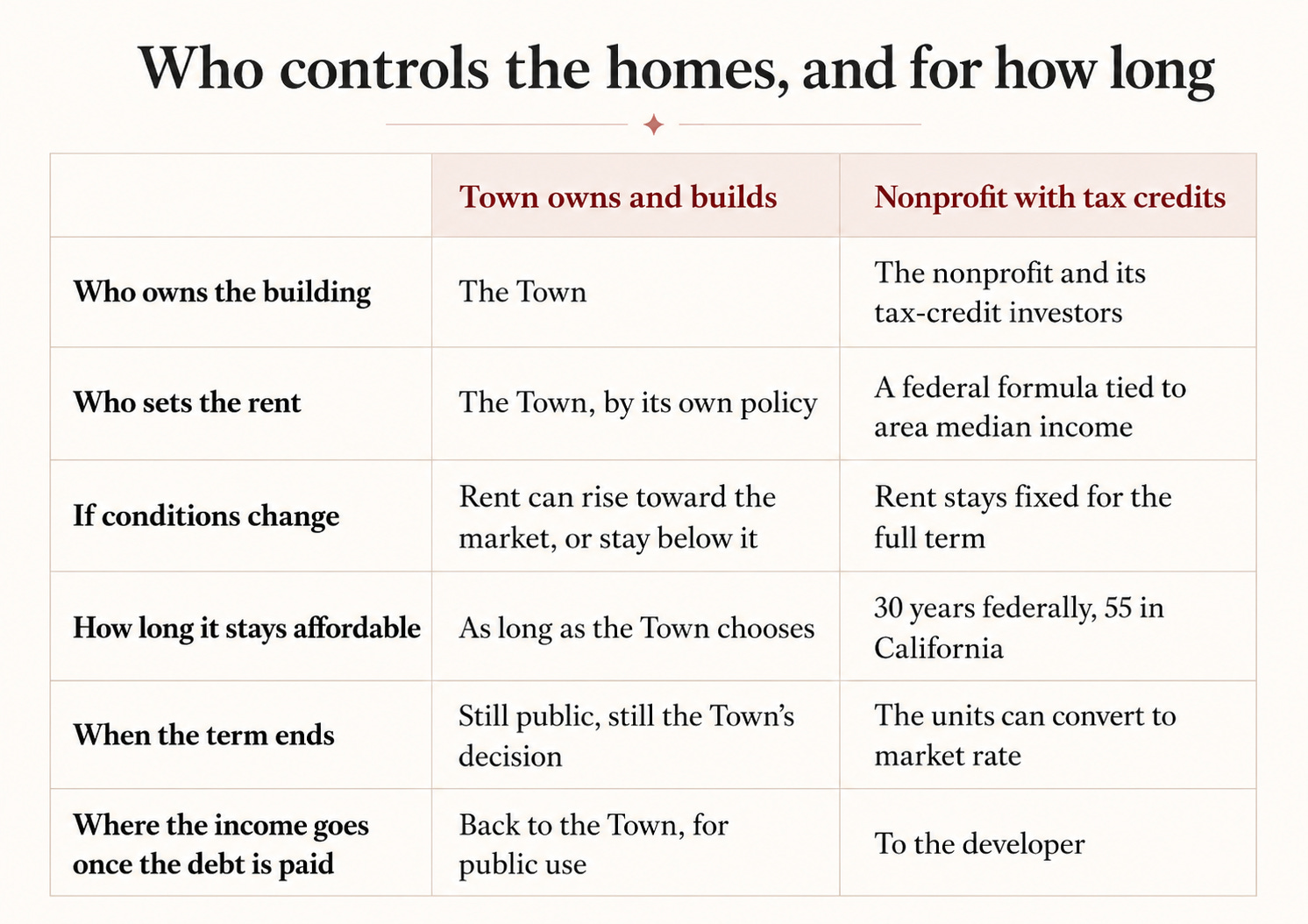
Keeping the land and the buildings in public hands was never about control for its own sake. It was about where the value goes. Once a phase has paid off its debt, the rents it produces keep arriving and belong to the Town to spend as the public needs. Inside that sits a subtler point. When a government owns housing and charges its workforce less than the market would bear, that discount is itself a subsidy. The Town collects less rent than the building could command, and it can make that choice freely because no outside party dictates the price. Its one hard obligation is the debt on the building, and that debt is carried by the rents the homes earn and by Measure S, the visitor-paid hotel tax behind the bond, not by anyone’s property taxes.
Because the discount is a choice and not a debt, the Town keeps the lever that matters. The worry most often raised about town-built housing is that the workforce it is meant for will not turn up, and the units will sit empty. Against an asset the Town owns, that risk is small. If demand from local workers ever fell short, the Town could let rents rise toward the market until they cleared, cover its debt, and wait. The building does not fail. It earns a little more for a time, houses someone else who needs a home, and returns to workforce rents whenever the Town decides.
None of this makes the tax-credit model illegitimate. It is often the only way affordable housing gets built at all. But it comes with tradeoffs in control, flexibility, and duration that are very different from direct public ownership. A nonprofit developer working through the low-income housing tax credit has no such lever, and that is the center of the comparison. In exchange for the credits that finance the building, the owner signs an agreement that caps every rent at a fixed share of the area median income and holds it there for at least 30 years under federal law and 55 in California. The rents move only as that income figure moves. The owner cannot lift a unit to the market when conditions change, cannot relax a restriction it no longer needs, or turn the building to another use. Each price is set by a federal formula and locked by contract for a generation. When the term finally ends, the owner is generally free to convert the units to market rate, which is the moment the affordability the public paid for quietly disappears. And that is about to happen to several deed-restricted workforce units in Yountville over the next year or two, so it’s not some strange abstract idea.
The contrast runs opposite to the one usually drawn. The model that sounds flexible, a tax-credit deal carried by a seasoned nonprofit, is the rigid one, its rents fixed and its affordability set to expire from the first day. The model that sounds risky, the Town owning what it builds, is the adaptable one, its affordability lasting as long as the Town wants and bending with circumstances rather than breaking against them. The first phase was to be financed with cash, a voter-approved bond, and a bank loan repaid from rents, precisely so it would carry none of those restrictions. That was the Town keeping its own hand on the wheel and being a careful steward for a public asset.
The phased structure was the second half of the same idea, and it is the part a Council member can explain most plainly. The site was divided into 18 parcels, meant to be built one phase at a time rather than all at once. Approving the plan did not approve the buildout. It approved a framework within which each phase would return to the Council as its own decision, taken in public and on the record when its time arrived.
Only the first phase carried numbers. It was roughly 40 homes at an estimated $25 million, to be funded with about five million dollars in cash, a bond backed by Measure S, the 1 percent visitor-paid hotel tax that brings in about $700,000 a year, and a bank loan the rents would repay. Every phase after it depended on tax credits, grants, and partners that did not yet exist, and each would have required a vote of its own. The Council could approve a phase, resize it, delay it, redirect it, or decline it altogether. None of that discretion was surrendered at the start, and keeping it was the whole reason the work was structured in phases.
This is also why the largest figure ever attached to the project, the roughly $91 million to build everything the site could eventually hold, was a ceiling and not a commitment. It described the maximum the property could absorb across many years and many separate votes. The Town had not agreed to spend it and could not have, because the votes that would authorize each phase had not been taken, and most never would be.
The plainest account of what the Town actually decided runs like this. It approved a set of entitlements that made the seven-acre school site far more valuable than it had been the day it was purchased, then ran the design-build procurement to the point of proposals in hand, meaning to take the leading Phase 1 bid into a fixed-price negotiation as it brought an operator on. What ended that was the ballot, not the bids. The Council’s June 2, 2026, resolution rejected all the proposals and cited changed conditions and cost assumptions, but the condition that changed was the entitlement itself. With the Commons zoning repealed by roughly 10 percent of the registered voters, every proposal had been priced against a project that no longer legally existed, and there was nothing left to negotiate. Every later phase had been left as a separate decision the Town’s elected representatives would make in public when its time came.
The former school held a particular place in the life of the town. It had been bought with public money, in part specifically to build workforce housing; residents had put two years of argument into its future, and the grounds had already begun working as a gathering place before any housing plan reached the table. Many felt the community deserved a real say in what happened next. Others disagreed, and the disagreement was legitimate. Reasonable people can hold different views about how far a local government should reach into what gets built. The choice in front of Yountville, though, was never between expertise and the lack of it.
For a short while, Yountville tried something that has grown uncommon. It kept an important piece of public land in public hands, asked the people who lived there to imagine what it should be, and prepared to bring in private skill to carry that out, one phase and one vote at a time. A referendum later set the housing aside, but a referendum can repeal an ordinance without unmaking the facts that produced it. The Town still owns the ground, and it still wrote the first version of the site’s future. The farmstand sells produce six days a week, the dog park fills most evenings, and the question of who should hold the pencil before the building starts is still worth asking plainly. At the Commons, for once, the answer was the town itself.
Brendan Kelly wrote this essay and served as Owner’s Design Consultant on the Yountville Commons from 2024 to 2026. That work is complete. He writes here as a private citizen with a disclosed interest in the project. Visit more essays like this at the Yountville Moon