

Summary: At the July 21 Town Council meeting, Vice Mayor Pam Reeves described from the dais how the campaign against the Commons zoning actually ran, a petition of 235 signatures, roughly a tenth of the electorate, timed to suspend the ordinance with no window for response. Councilmember Hillery Trippe answered with a speech about the right to assemble in private, and the town's newly resurrected newspaper reported the exchange as one council member criticizing another. This essay traces the operation in four steps, doubt, defeat, end run, and laundering, and draws the line the series is named for. Influence argues its case in the open and lives with the outcome. Control acquires the machinery the argument runs on. Meanwhile the same agenda carried a staff report showing the town behind on its housing obligations, deed restrictions expiring beginning February 2027, and a standing question no petitioner has answered: name the site where workforce housing belongs.
The Most For-Sale Town in Napa
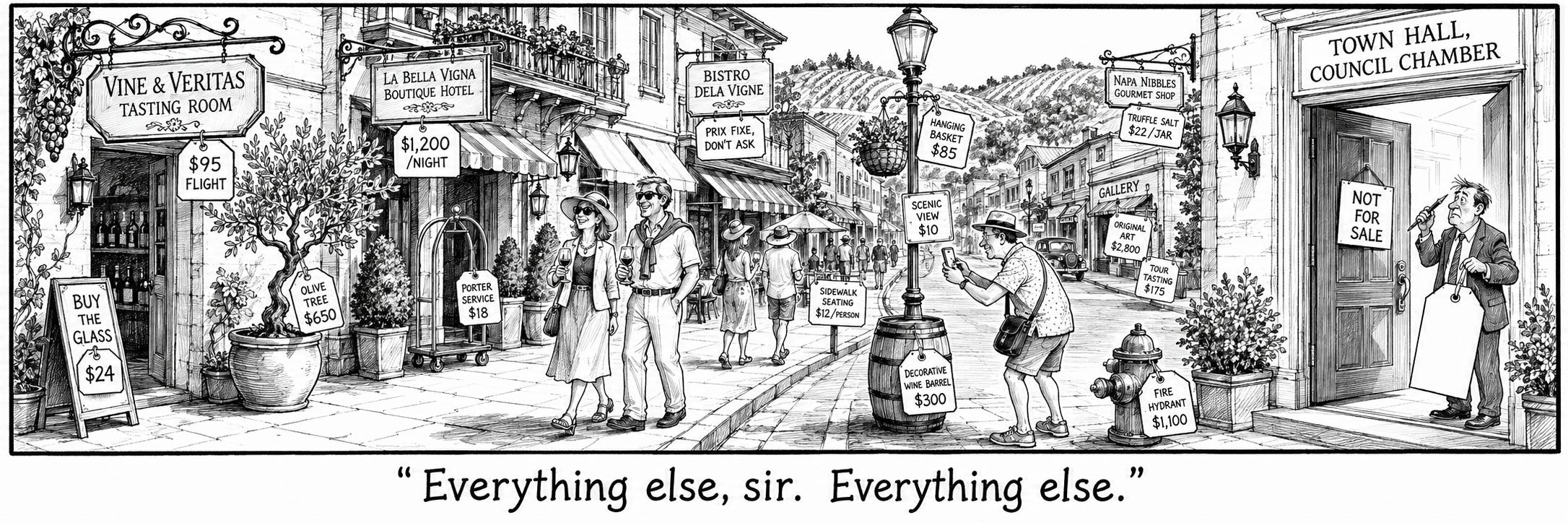
A word about this series’ title, because the ironists in the audience have surely noticed. Yountville is for sale. It is the most for-sale town in Napa County. It is nine blocks of things for sale, and expensive ones. You can buy a tasting flight that costs what a tank of gas costs, a hotel night that costs what a mortgage payment costs, and a tasting menu that costs what the hotel night costs, and people fly across oceans to do all three in a weekend. And may God bless them! The town’s entire economy is the cheerful, unembarrassed conversion of beauty, food and wine into revenue. Nobody here is against commerce. Commerce built the sidewalks. Commerce, through Measure S, is supposed to build the workforce housing.
So the title is not a complaint that money has arrived in Yountville. That train left in the sixties and came back as the wine train. The title marks a different line, one every resort town knows about and hopes never to cross. A town can sell you dinner, a room, a bottle, an afternoon. What it cannot sell, or the moment it does it stops being a town, is the government. The wine list is for sale. The council is not. The hotel room is for sale. The zoning map is not. The distinction sounds obvious until you watch it blur in real time, which is what this series is documenting.
The Sun Also Rises
Speaking of things for sale, a happy announcement. The Yountville Sun is back.
This deserves a moment of appreciation, because small-town newspapers do not come back. They die, and everyone says something kind at the funeral about the fabric of community, and the racks stand empty outside the market forever after. The economics are famously terminal. Print advertising is gone, subscriptions cannot carry a staff, and a paper serving 2,900 residents is, as a business, a machine for losing money. Yet here is the Sun, risen, publishing, covering council meetings with a full-time government reporter, in a town of nine blocks. It is a miracle of the modern media economy, and the paper has so far shown a curious modesty about it. The most interesting business story in Yountville this year is the Sun’s own resurrection, who paid for it, and what a buyer expects from an asset that cannot pay for itself. Maybe someday they will report that story. Until they do, readers are left to apply the one rule of resort-town economics the Sun itself would endorse: nothing in Yountville is free, and somebody always picks up the check expecting something.
The Civics Lesson
Hold that thought. The town is going to need this next part by November.
Politics is the argument a community has with itself about what to do next. Not about who is nice, not about who was rude at a meeting, not about hurt feelings on a dais. About what to do. Should the town build housing on the land it owns, or should it not. Should the hotel tax voters approved go where voters sent it, or somewhere else. Those are policy questions, and the argument over them is what political speech is. The founders did not protect speech because they thought everyone would agree. They protected it because they knew everyone would not, and they wanted the fight to happen in the open, in front of the whole room, where every citizen could hear both sides and judge. That is why towns have council chambers. The chamber is the room where the argument is supposed to happen, on the record, in the minutes, on the video archive, in front of every voter at once. A council member arguing policy from the dais is not corrupting democracy. She is performing its central act.
July 21
Now replay the meeting with that in mind.
Vice Mayor Pam Reeves opened the meeting with a list. The barbecue. The shade structures. The water tank. The $250,000 federal microgrid grant. The Entertainment Zone. The Coop, the community garden, the Locals Lounge, the dog park, Yountville Fit, much of it running right now on the Commons site the town keeps being told is a failure. It was a long list, and if it sounded unfamiliar, there is a reason. The Sun, in either of its lives, never covered it. Three years of a small-town government quietly delivering, and the paper of record found little of it fit to print. A town that knows its government is working is a hard town to divide. Remember that. It matters shortly.
Then Reeves said the hard part. A majority of this council, she said, is committed to a democratic process that centers on public meetings, where all are welcome. She was saddened that one council member decided to go outside that process. The chaos of 235 who signed a petition, she said, now looks like an end run to manufacture division at election time.
Councilmember Hillery Trippe identified herself as the subject, objected that the dais is no place for political speeches, and then delivered one, about the right to assemble in private, to gather in a house with only the people you invite, to criticize government at any volume. All of it is true. None of it is responsive. Nobody in that room questioned her right to assemble. Reeves questioned what the assembly was for. And to that question Trippe offered the Constitution’s confetti and not one word of policy. Not a site. Not a number. Not a plan. The council member who spent two years demanding more information had, on the one question that matters, none to give.
The Operation
Watch how the operation actually ran, because the record lays it out like a diagram.
Step one, the doubt. Through the design and procurement process, Trippe positioned herself as the diligent skeptic. More information about the consultants. More questions about the numbers. More process, always more process. It sounded innocent, and that was the point. Just asking questions is the oldest device in the outlier’s kit. It costs nothing, concedes nothing, and deposits a residue of suspicion on everything it touches. The questions were asked. The answers were given, in staff reports, in the financial analysis, in bond counsel’s work, in public meeting after public meeting. The residue remained, because residue was the product.
Step two, the vote. The council voted. Trippe lost, fair and square, in the open, in the chamber, by the process she now says she reveres. In a functioning democracy that is where the story ends. The minority makes its case, the majority decides, everyone stands for election on the result.
Step three, the end run. Instead, a petition. Two hundred thirty-five signatures, roughly a tenth of the electorate, gathered and filed on a clock timed so the ordinance would be suspended with no practical window for the council to respond before the appeal period ended. Understand what that timing buys. It converts a policy defeat into a procedural ambush. It moves the argument out of the chamber, where the whole town can watch, into doorways and living rooms, where only the invited are present and only one side speaks dramatically and unopposed in the “public comment” period. Trippe stood at the dais on July 21 and celebrated exactly that venue. You can assemble, she said, where no one else was invited. Yes. You can. And when a sitting council member who lost a public vote helps move the decision into rooms where no one else was invited, she has not discovered the First Amendment. She has abandoned her post.
Step four, the laundering. An operation like this needs one more thing. It needs to look like it came from nowhere and everywhere, a spontaneous uprising of concerned neighbors. That is a job for a newspaper, and what luck, the town suddenly has one again. For months the campaign against the Commons zoning was covered as organic civic concern, never as what the record shows, an organized, funded, lawyered effort with legal letters aimed at town consultants and talking points that moved in lockstep across public comment. Signature gatherers were neighbors. Legal threats were questions. The council’s accomplishments went unreported, and the division deepened on schedule. Then, on July 21, the vice mayor finally described the operation out loud, and the Sun located the first aggression of the entire affair. The headline was not about a suspended zoning district, a $1.7 million median home, or a state deadline bearing down. It was about one council member criticizing another. Years of campaign, and the attack begins, per the Sun, at the moment someone answers back. In its coverage of a fight over the town’s future, the paper has yet to mention that its own resurrection is a purchase, and that its buyer’s opposition to the project in question is a matter of public record. This publication discloses its author’s history with the Commons at the bottom of every essay, including this one. A newspaper owes its readers no less, and the absence of the disclosure is itself information.
Influence and Control
This is what the series title means, stated plainly. Influence is when monied interests show up at the public meeting, hire the consultants, write the op-ed, and make their case to a council that will decide either way. Influence is legal, ordinary, and as old as the republic. It is a voice in the argument. Control is when the interests stop arguing and start acquiring the machinery the argument runs on. The newspaper that decides which facts circulate. The petition apparatus that decides which votes stand. The candidate slate that decides who sits on the dais. Control does not petition the government. It replaces the audience, the referee, and eventually the players, and then holds a public comment period on itself. A town under influence still argues about what to do next. A town under control still holds the meetings, prints the paper, and conducts the elections, and none of it decides anything, because the deciding has moved to rooms where no one else was invited. Yountville has crossed from the first condition into the borderlands of the second, and the purchase of its newspaper is the latest marker on the trail.
Reeves did not speak for sport. Her constituents have been asking, with increasing volume, why nobody on the dais will stand up to this. The town is divided, and the division did not condense out of the fog. It was built, deliberately, by a small group that needs division to win, because its actual position, that a tenth of the electorate should override the 72 percent who approved Measure S, cannot survive an undivided town looking straight at it. Reeves stood in the chamber, on the record, in front of everyone, and said so. That is what the room is for.
And the problems the operation was built to obscure sat in the very same agenda, in a staff report that drew a fraction of the attention. Planning Director Aaron Hecock told the council the town is not on pace to meet its very low income RHNA obligation. Less than 10 percent of Yountville’s housing is affordable to moderate and lower income households. Roughly 20 percent of the existing affordable stock could lose its protections within a decade, beginning in February 2027. The median home runs $1.35 to $1.7 million and requires an income between $365,000 and $515,000. The median low income for a single person is $98,700, which in Yountville buys neither. The remaining housing sites are a handful of privately owned parcels, each requiring a willing owner, a negotiation, and a price. The Commons is the one site the town controls, with funding voters already dedicated. That is what 235 signatures suspended. The signatures did not suspend the state’s math, the deed restriction calendar, the threat of decertification, or a builder’s remedy filing. Four months on, not one petitioner has stood at the public microphone and named where the housing should go instead. They never had an answer. Delay was the answer. The election is the goal.
So here is the standing question, for Trippe, for every petitioner, and for every candidate who pulls nomination papers before August 7. Name the site. If not the Commons, then where, at what density, funded how. Say it in the chamber, on the record, in front of all the residents. Everything else in this town is for sale, and the town has done handsomely by the arrangement. The question this election answers is whether the price tags stop at the chamber door.
This is the second essay in the series The Town of Yountville Is Not For Sale, which will run through the November 3 election.
Next in the series: Who Rescued the Yountville Sun, and Why?
Disclosure: The author served for approximately two years as Owner’s Design Consultant on the Yountville Commons project, a role that concluded before this publication began. He writes as a private citizen. And in case you didn’t notice, the Yountville Moon is free.