

Summary: Gary Jabara’s company put $25,000 into Build a Better Yountville, a political committee that reported spending $22,000 on yard signs supporting Joe Tagliaboschi for mayor and Hillery Trippe, Jessi Bugden and Jill Turner for Town Council. The candidates did not receive Jabara’s money, and the filings do not establish coordination, a promise or a quid pro quo. California treats properly independent political spending differently from contributions made directly to candidates.
That legal distinction, however, is only the beginning of the story. Jabara is a major Yountville hotel and property owner. Earlier this year he participated in the fight over the Commons. This summer he bought the Yountville Sun. Now his company is financing political advertising supporting four candidates for the government that regulates property and land use in town. He has also submitted a design-review and change-of-use application involving Vintage 1870, although I have requested those records and will not characterize the proposal until I have reviewed the actual application.
None of this proves that a candidate has been bought or that Jabara expects favorable treatment. It does establish something voters are entitled to understand before Election Day: who is spending substantial money trying to influence the composition of Yountville’s government, and what economic interests that spender has in the town.
In a community this small, $25,000 is not background noise. This essay follows the money, explains California’s wonderfully peculiar rules for independent political spending, and asks the questions the disclosure laws leave to voters: Why does this election matter enough to a major property owner to spend this money, what do the candidates supported by that spending say about it, and how much weight should Yountville residents give those facts when they cast their ballots?
By Brendan Kelly
FIRST CAME THE MONEY
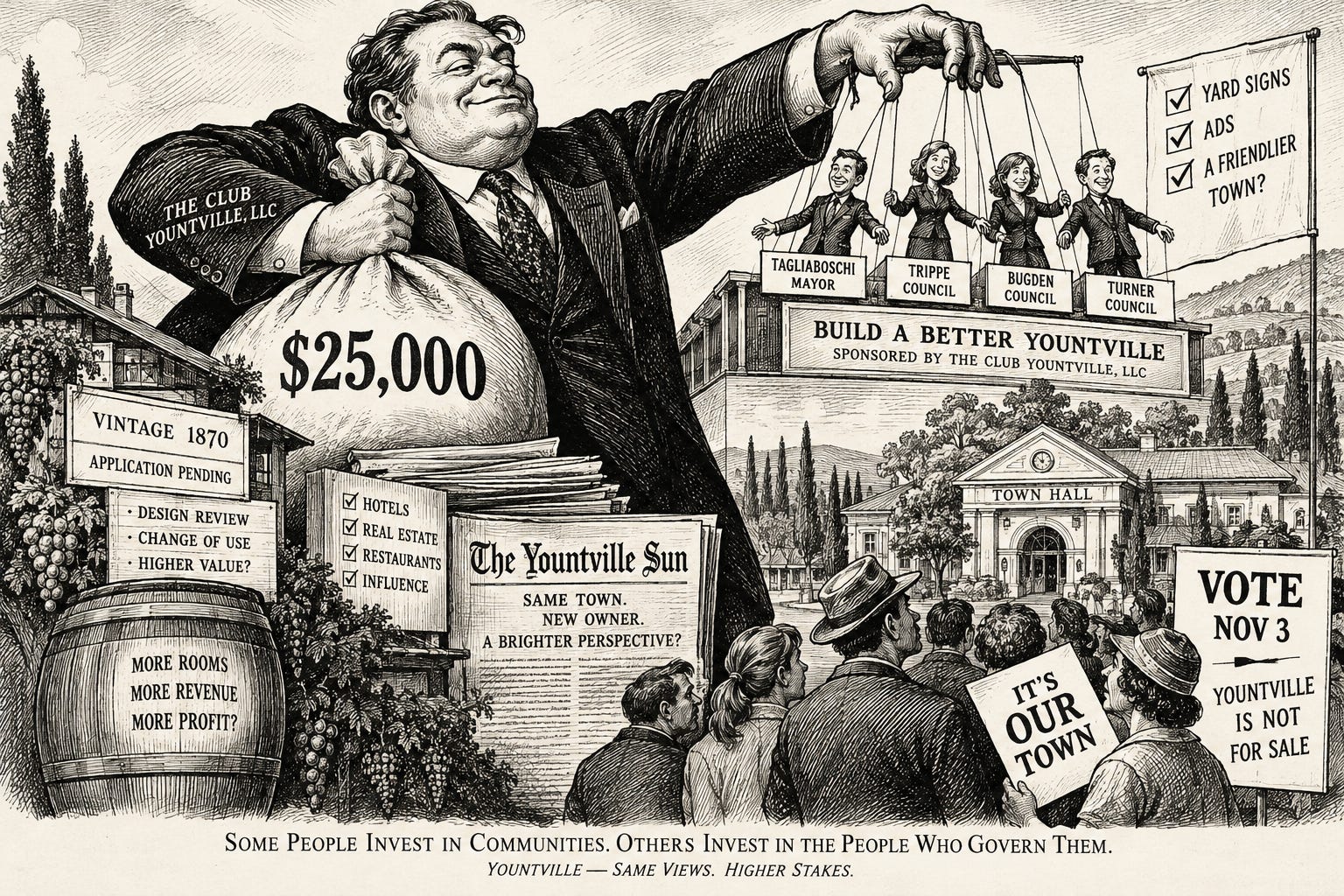
On September 2, The Club Yountville, LLC put $25,000 into a political committee with the wonderfully aspirational name Build a Better Yountville, Sponsored by The Club Yountville, LLC. The paperwork identifies Gary Jabara as the company’s responsible officer. Thirteen days later, on September 15, the committee filed four reports showing $7,300 spent on yard signs supporting Joe Tagliaboschi for mayor and $4,900 each supporting Hillery Trippe, Jessi Bugden and Jill Turner for Town Council. Add them up and you get $22,000 spent supporting four candidates for the government of one very small town.
The first thing to understand is what those documents do not say. They do not say Jabara gave Tagliaboschi $7,300. They do not say he gave Trippe, Bugden or Turner $4,900 apiece. They do not establish that any of the candidates asked for the spending, approved it, coordinated it or promised Jabara anything in return. California calls these independent expenditures, and the distinction is not decorative. State law says spending ceases to qualify as independent when it is made in cooperation or consultation with a candidate, at a candidate’s request or suggestion, or through an arrangement or coordination with the candidate or the candidate’s agent.
So let us begin by denying ourselves the easiest accusation. There is no evidence in these filings that Gary Jabara bought four candidates. There is evidence that his company supplied $25,000 to a committee that then spent $22,000 trying to help elect four candidates. That is not the same thing, legally or factually, and pretending otherwise would make this story less interesting rather than more.
Because what Jabara has done openly is interesting enough.
CALIFORNIA HAS A RULE FOR THIS
California has spent half a century worrying about money in politics, which is approximately how long California politics has spent giving it reasons to worry. The Political Reform Act regulates campaign financing, conflicts of interest and governmental ethics. It requires public disclosure of campaign money so voters can identify who is financing political activity, and the Fair Political Practices Commission says one of the law’s purposes is to promote transparency and fair governmental decision-making.
California becomes particularly attentive when campaign money approaches permits, licenses, contracts and other valuable governmental permissions. Government Code Section 84308, generally called the state’s pay-to-play law, restricts certain direct contributions from parties and participants in covered proceedings. Under the current rules, a party seeking a covered permit or other entitlement generally may not contribute more than $500 to an officer of the agency while the proceeding is pending and for 12 months afterward. Certain officials who have received more than $500 from a party or participant during the preceding 12 months can also face restrictions on participating in that proceeding.
The reasoning is not terribly mysterious. A campaign contribution may be worth hundreds or thousands of dollars. A discretionary land-use approval may be worth millions. California therefore decided that when somebody asking the government for something valuable also gives campaign money to the official deciding whether he gets it, perhaps everybody should put down the cheese plate and pay attention.
Independent expenditures are different. California permits genuinely independent political spending because spending money advocating for candidates is not legally the same thing as giving those candidates the money. The California Fair Political Practices Commission (FPPC) defines an independent expenditure as one not made in consultation, cooperation or coordination with the affected candidate or committee. The law is therefore capable of producing a situation in which a property owner’s company can finance thousands of dollars in political advertising supporting candidates for local office while those candidates can accurately say that the money was never contributed to them.
That is not a loophole I have discovered behind a filing cabinet in Sacramento. It is how the system is designed. And Gary Jabara is using it.
WHY YOUNTVILLE GOVERNMENT IS WORTH CARING ABOUT
If Jabara owned a chain of laundromats in Fresno, his fascination with the composition of the Yountville Town Council might require considerably more explanation. He does not. He owns substantial hospitality and real-estate interests in Yountville, where extraordinarily valuable property sits inside an extraordinarily small municipality and where decisions made by local government can have substantial economic consequences.
This is where my own profession becomes useful. I have spent much of my career working on hotels and complicated development projects. Hotel owners do not hire architects, engineers, land-use lawyers and planning consultants because they have grown lonely. They hire us because owning property and being allowed to do what you want with property are entirely different experiences. The deed gets you through the front door. Zoning, design review, historic-preservation rules, environmental review, conditional-use permits and discretionary approvals determine what happens after you arrive.
That is particularly true in Yountville, where the physical character of the town is both a civic inheritance and an extraordinarily profitable commercial asset. The charm is monetized nightly. The vineyards, old buildings, walkable streets and carefully managed scale that residents think of as their town are also part of what visitors are buying when they spend several hundred or several thousand dollars to sleep here. The public therefore has an interest in controlling change, while major property owners have an entirely rational interest in what changes the government will permit. None of this makes Gary Jabara sinister. It makes him a property owner. It also makes the composition of the Yountville government worth money to him in a way it is not worth money to most of us.
THEN CAME THE COMMONS
Earlier this year, Yountville got an unusually clear lesson in the mathematics of political power in a very small town. The Town had spent years planning the Commons on the former elementary-school property, including workforce housing and public improvements. Opposition coalesced around the ordinance implementing the zoning. A petition gathered roughly 235 signatures, and in June the Council repealed that ordinance, returning the property to its previous zoning framework and forcing the Town to reconsider how to proceed.
The Commons did not vanish. The Town still owns the property. The conceptual planning did not spontaneously combust. Yountville’s housing obligations did not disappear because 235 people signed something. The Council backed up in the entitlement process rather than abolishing the idea that the publicly owned site might have a future involving housing and civic uses.
Politically, however, something important happened. Roughly 235 signatures changed the direction of a major public undertaking. In San Francisco, 235 angry residents constitute the line for brunch. In Yountville, they can alter municipal policy.
That is neither praise nor criticism. It is arithmetic. A town this small does not require a mass political movement to change direction. It requires organization, an issue capable of motivating people and enough voters to make elected officials understand that proceeding has acquired a political price.
Jabara participated in the opposition surrounding the Commons. Whatever else one thinks about that fight, it demonstrated something useful to everyone watching it: Yountville is movable. The levers are close to the ground, the electorate is small and a relatively modest number of people can produce a consequential political result. The next logical question is what happens when the objective is not stopping an ordinance but electing the people who write them.
THEN CAME THE NEWSPAPER
This last summer Gary Jabara bought the Yountville Sun.
That fact does not make the newspaper dishonest. Newspapers have owners, and owners have interests. William Randolph Hearst was not in the newspaper business because he had an unusually deep affection for printer’s ink. The appropriate response to ownership is not hysteria but literacy: readers should know who owns the institution selecting the stories, framing the disputes, questioning the candidates and deciding which facts deserve prominence.
In Yountville, the ownership is particularly relevant because the newspaper’s new owner is not merely a publisher. He is also the major local property owner who had participated in one of the year’s largest land-use controversies and whose company would soon finance political spending supporting four candidates for the government regulating those interests.
Again, chronology is not conspiracy. Buying the Sun does not prove that Jabara bought it to influence an election. Opposing the Commons does not prove that he did so to advance some unrelated property interest. Financing independent expenditures does not prove that the candidates receiving the benefit of that advocacy owe him anything. Serious journalism should be able to hold several facts in its head without immediately dressing one of them in a trench coat.
But serious journalism should also be able to put dates in order.
First came the Commons fight. Then came ownership of the local newspaper. Then came $25,000 from Jabara’s company to a political committee supporting four candidates for Yountville office. At some point, “nothing to see here” becomes a surprisingly strenuous position to maintain. Even for the Yountville Sun.
AND NOW THERE IS AN ELECTION
This is where the story arrives at the ballot.
Build a Better Yountville is not spending $22,000 because it wants residents to admire its typography. Political advertising has a purpose. The four filings themselves mark the expenditures as SUPPORT for Tagliaboschi, Trippe, Bugden and Turner. Whatever else anyone believes about Gary Jabara’s motives, there is no need to speculate about what these particular expenditures are intended to accomplish. They are intended to help those four candidates get elected. That does not make the candidates Jabara’s candidates in some legal or proprietary sense. It means Jabara’s company financed a committee that prefers them to the alternatives. Coca-Cola does not buy advertising because it is neutral about whether you drink Coca-Cola. Toyota does not spend money advertising Camrys because it hopes you will carefully consider all available sedans. Political committees do not spend thousands of dollars putting candidates’ names on signs because they are conducting a sociological experiment in corrugated plastic.
They want those people elected.
The candidates themselves therefore deserve precision rather than insinuation. There is no evidence in these filings that any of the four coordinated with Jabara. There is no evidence here of a promise, bargain or quid pro quo. There is no evidence that any of them would vote a particular way on a future matter involving one of his properties. There is also no reason voters cannot ask them about the support.
A candidate can be asked whether substantial independent spending from Jabara’s company is welcome or unwelcome. A candidate can be asked what independence from a major financial supporter means in practice. A candidate can be asked whether Jabara and his businesses would receive exactly the same treatment before the Yountville government as any other applicant. Those questions do not accuse anybody of corruption. They are the questions disclosure makes possible. And they should be answered before the election, because that is when the answers are useful.
THE BUILDING THAT EXPLAINS THE STAKES
There is one more piece of this story, and its importance is not what happens after Election Day. Its importance is what it tells voters before Election Day about why local government matters to a major property owner.
Jabara has submitted a design-review and change-of-use application involving Vintage 1870, the historic Groezinger Winery complex. I have filed a public-records request for the application and supporting documents and expect to review them next week. Until I have the actual plans in front of me, I am not going to speculate about what Jabara proposes or tell readers what to think about it. Once the records arrive, I will examine the drawings, proposed uses, history of the property, applicable regulations and the public approval process, and report what the application actually asks Yountville to approve.
For this election, Vintage 1870 matters for a narrower and much more immediate reason: it puts an actual property, an actual application and potentially valuable governmental permissions behind all this political spending. Gary Jabara does not merely have opinions about how Yountville should be governed. He owns valuable property there, and he has submitted an application asking the Town to approve changes involving one of those properties. California itself recognizes the financial significance of land-use decisions: its pay-to-play law expressly includes land-use permits and other entitlements among the governmental proceedings where campaign contributions can create concerns about influence.
That is the economic stake voters should understand. A government approval can affect what a property owner may build, how a building may be used, how intensively it may operate and, ultimately, what that property can earn and what it may be worth. I do not yet know what Jabara is asking Yountville to approve at Vintage 1870 because I have requested the application and supporting records and will review them next week. But the existence of the application makes one point unmistakably concrete: the people elected to govern Yountville are not merely debating civic philosophy. They occupy a government that makes decisions capable of affecting the use and value of Gary Jabara’s property and his financial assets.
That does not prove Vintage 1870 motivated his political spending, and it does not prove that any candidate supported by his committee would give him a favorable decision. Those would be conclusions in search of evidence. But voters do not need either proposition to understand the stakes before them. Jabara’s company has put $25,000 into a committee supporting four candidates for Yountville office at a time when Jabara owns substantial property interests in the town and is seeking governmental approval concerning at least one of them. That is not a theory about why this election matters to him. It is an explanation of why who governs Yountville can matter financially to a property owner like Gary Jabara.
THIS IS WHAT THE ELECTION IS ABOUT
Yountville can now dispense with one particularly useless argument: whether Gary Jabara is allowed to participate in its politics. Of course he is, subject to the same campaign laws that apply to everyone else. He can oppose the Commons. He can buy a newspaper. His company can finance independent political advocacy. He can support candidates he believes would govern differently. There is nothing inherently improper about a businessman wanting a government more sympathetic to his ideas.
The interesting question is whether Yountville voters want the same government he does.
That question cannot be answered by counting yard signs, and it cannot be answered by treating every candidate supported by Jabara’s committee as somebody’s purchased employee. It requires voters to examine the people seeking office: their records, their positions, their independence, their answers about land use and housing, and what they say when asked directly about the substantial outside spending being made on their behalf.
This is why the September filings matter now. Not because residents should laminate them and wait three years for an interesting planning hearing. Not because they prove corruption. Not because $25,000 is some staggering amount of money in the universe of American campaigns. They matter because Yountville is holding an election, one company associated with a major local property owner has put $25,000 behind a committee supporting four candidates in that election, and voters are entitled to consider that fact while their votes can still affect who governs them.
The FPPC’s rules cannot tell a voter what weight to give that information. They are not supposed to. California requires disclosure because disclosure leaves the judgment where it belongs: with the person holding the ballot. The state can force political money into daylight. It cannot decide what a citizen should think after seeing it.
That is the call to action in Yountville between now and Election Day. Read the filings. Ask the four candidates what they think about the spending being made to support them. Ask every candidate how he or she would protect independent judgment when major economic interests come before the Town. Examine their records rather than their signs, and decide which candidates have earned your trust. Nobody needs to accept my conclusion about Gary Jabara, because the more important conclusion belongs to each voter.
A man with substantial property interests in Yountville has made his preference unusually easy to identify. His company’s money is on the table, the committee’s expenditures are disclosed, and the four names it supports are printed in black and white on California campaign filings. That is useful information, but it is not the election result. The result belongs to the people who actually cast the ballots, and they get to decide for themselves whether Gary Jabara’s preferred government is also the government they want. That is a considerably more consequential decision than where to put another yard sign.