

Summary: The Yountville Sun’s candidate questionnaire presents itself as fair and balanced, but its questions continue a familiar pattern: intense scrutiny of the Commons, Town spending and the current Council, with far less attention paid to the small group of residents and business interests that organized to stop the project. This essay argues that the paper’s framing has helped deepen Yountville’s divisions by repeatedly placing Town Hall in the defendant’s chair while allowing the people who drove the opposition to avoid comparable accountability. The larger question is not simply what went wrong with the Commons, but why it was proposed in the first place, what delaying it has cost, and what those who fought it intend to do instead.
The Questions Before the Answers
The Yountville Sun has sent fourteen questions to the candidates running for mayor and Town Council. Every candidate gets the same questions. Everyone gets the same word limits. The answers will apparently be printed without editing. On that narrow procedural level, the exercise is fair.
But journalism is not made fair simply by handing everybody the same questionnaire. The more important editorial decision occurs before any candidate answers: What gets asked? What history is supplied in the question? Which controversies deserve scrutiny? Who is expected to explain himself? And, perhaps most importantly in Yountville right now, who is not?
Read the Sun’s questionnaire from beginning to end and a remarkably consistent picture emerges. The Town spent too much money. The Commons became too ambitious. Residents were not adequately heard. Transparency was questionable. Financial oversight may have been inadequate. Conflicts of interest deserve examination. Civility is a problem. The current Council has a great deal to answer for.
Those are all legitimate subjects, but they are only one side of the story. Where are the equally persistent questions about the residents and business interests that organized against the Commons? Where is the examination of the consequences of delaying it? Where are the questions about what those opponents proposed instead, what their alternatives would cost, how many homes those alternatives would actually produce, or what interests the principal participants themselves bring to the debate? The spotlight somehow keeps returning to Town Hall.
That has become the Sun’s central problem in covering the Commons. The issue is not that it asks difficult questions. It should. The issue is that the difficult questions seem to travel overwhelmingly in one direction.
There Was No Vote Rejecting the Commons
One point needs to be stated carefully because language has begun to distort the history. The Commons was not rejected by Yountville voters. There was no townwide election in which a majority of residents voted against the project.
A referendum petition challenging Ordinance 26-539 qualified under California election law. Once it qualified, the Town Council was required either to repeal the ordinance or place it before the voters. The Council chose repeal. There was no referendum election and therefore no public vote rejecting the Commons. The Town’s own account describes that sequence.
That distinction is not semantic nitpicking. Politically it matters enormously. Repeatedly referring to what happened as “the referendum” can leave residents with the impression that the people of Yountville went to the polls and rendered a verdict. They did not. A petition obtained enough signatures to invoke the referendum process, and the Council subsequently chose repeal rather than an election.
The petition itself represented a relatively small but organized portion of the electorate, not a majority decision by the town. That group had every right to use the legal process available to it. The problem begins when its success is treated as though it settled the larger civic argument or demonstrated that Yountville as a whole rejected the purpose behind the Commons. It did neither.
If the Sun intends to make precision, transparency and accountability recurring themes of its campaign coverage, then it should be precise about this history too.
Opposition Is Part of the Story
The larger problem is what happened before and after the petition. A small but highly motivated group opposed the Commons. Some of their objections were legitimate and deserved serious examination. Cost mattered. Scale mattered. Parking mattered. Financing mattered. The Town should have been pressed hard on every one of those things.
But opposition also has consequences. Stopping a project is not the same thing as solving the problem the project was created to address. The former school did not suddenly become free. The workforce-housing shortage did not disappear. The people who work in Yountville did not suddenly begin living here. Measure S revenues did not lose their legally dedicated purpose. The State did not cancel Yountville’s housing obligations. The millions already invested in acquiring and improving the school property did not magically return to the Town treasury.
Those facts remained after the petition just as surely as they existed before it. Measure S, approved by Yountville voters in 2018, created a dedicated hotel-tax revenue stream for affordable and workforce housing. The Commons grew out of a much larger effort to decide what to do with a rare piece of publicly controlled land in a town where housing ordinary working people has become increasingly difficult.
Residents can disagree, vigorously, about whether the Commons was the right answer. They can believe it was too large, too costly or too ambitious. But once they succeed in stopping it, another question necessarily follows: What do we do instead?
That is the question the Sun has rarely pursued with the same enthusiasm it brings to investigating the people who tried to build something. It is much easier to ask why the Council spent money than to ask what several years of delay will cost. It is easier to ask whether the Commons was too large than to ask where the missing housing should go. It is easier to ask whether elected officials have conflicts than to examine the financial and land-use interests of the people leading the opposition.
The critics get to remain critics. They can object to density without producing a site plan. They can condemn cost without producing a financing plan. They can demand fewer homes without explaining where the remainder should be built. They can invoke “community character” without explaining how a town that imports most of its workforce every morning preserves very much of a community at all.
Through much of this argument, the Sun has provided the microphone.
A Real Project Versus an Imaginary One
The Commons became vulnerable in part because it became real. It had drawings, costs, unit counts, parking assumptions, public meetings, financing problems and all of the other disagreeable characteristics that attach themselves to an actual project. Its opponents therefore had something concrete to attack, while their preferred alternatives could remain pleasantly undefined.
Imaginary projects enjoy enormous political advantages. They are cheaper. They are smaller. Their architecture is always more compatible with “community character.” Their parking works perfectly. Their financing is sensible. Nobody objects to their height because nobody has drawn an elevation. They are wonderfully easy to support because they exist nowhere except in conversations and campaign literature.
The Commons did not have that luxury. It became real enough to criticize.
That asymmetry has shaped much of the public debate, and the Sun has too often reinforced it. The paper repeatedly asks what the Town spent, whether the project became too large, whether the Council listened sufficiently and whether elected officials have conflicts of interest. Those questions deserve answers. But a serious examination cannot end with them.
The people who worked to halt the Commons should also be asked what they would build instead, where they would build it, how many homes their alternative would produce, how it would be financed and what the delay they helped create will ultimately cost. Opposing a government project does not exempt anyone from explaining the consequences of prevailing.
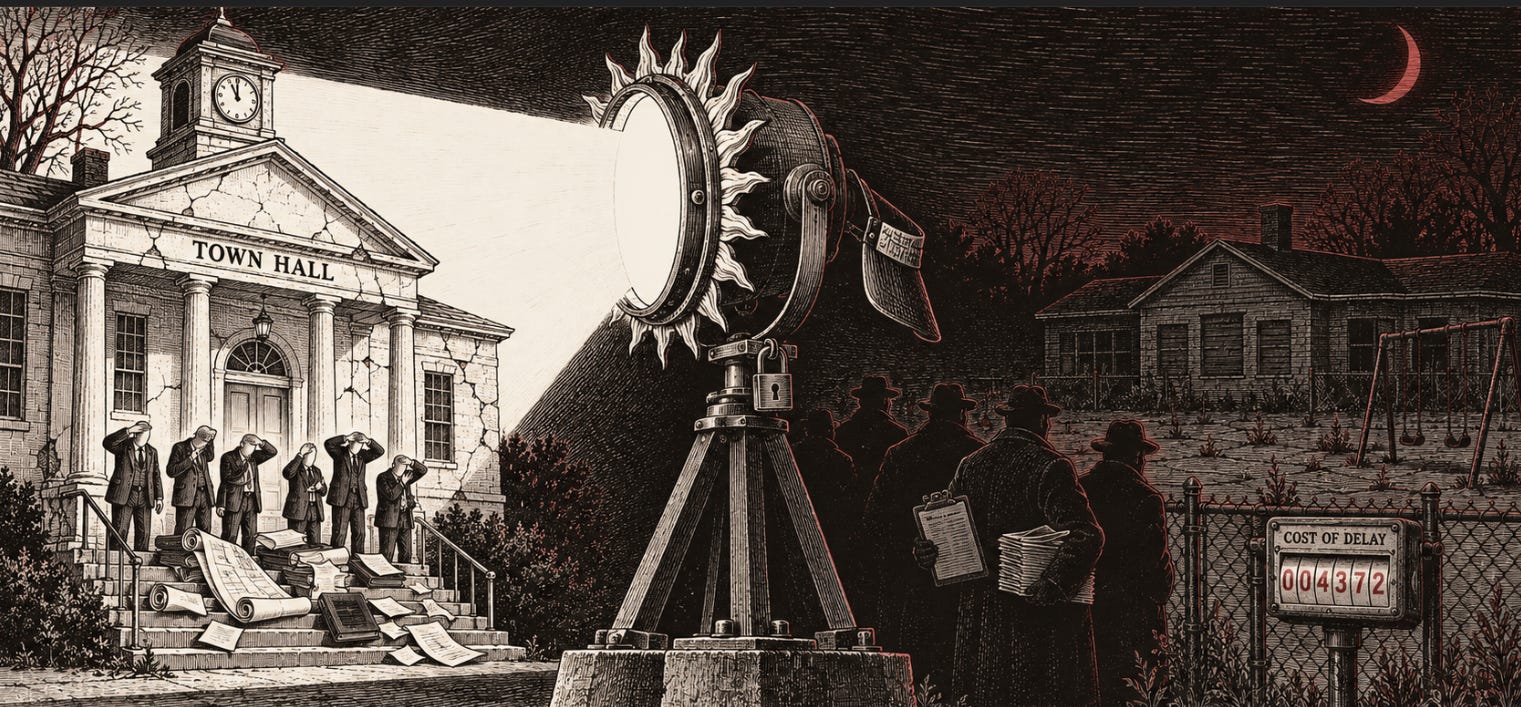
The Searchlight Stops at Town Hall
This is why the Sun’s candidate questionnaire deserves closer scrutiny. The problem is not that its questions are tough. Tough questions are exactly what a local newspaper should ask. The problem is that the toughness continues to run overwhelmingly in one direction.
The Council and the Commons remain the whipping post, while the organized opposition remains mostly outside the beam. The questionnaire asks candidates about Town spending, public trust, conflicts of interest and the future of the school property, but it shows much less curiosity about the residents and business interests who helped derail the adopted zoning or about what those people propose now that they succeeded.
A newspaper calling its work fair and balanced should recognize that fairness is not achieved merely by giving every candidate the same premise and the same number of words in which to respond. Fairness also requires examining the premise itself. If the Town is being asked to explain its spending, the people who stopped the project should be asked to explain the cost of delay. If elected officials are being asked about conflicts of interest, major business and property interests participating in the political fight should be examined too. If candidates are asked what they would do with the school, opponents who demanded a different future for the property should be pressed to describe one that can actually be built.
That is not partisan journalism. It is ordinary reporting.
Ownership Makes Independence More Important
Gary Jabara’s ownership makes this imbalance impossible to ignore, although it should not be exaggerated into a conspiracy for which there is no evidence. Before purchasing the Sun, Jabara had publicly challenged the Commons and filed a broad records request concerning its costs and process. The Sun itself reported his opposition. After the newspaper stopped publishing, Jabara bought it and subsequently spoke of his admiration for its previous Commons coverage.
None of that proves that he dictates coverage, writes questionnaires or instructs reporters what to say. It does create an obvious journalistic obligation. When a major commercial property owner who was already a participant in a contentious land-use dispute purchases the newspaper covering that dispute, the most convincing demonstration of editorial independence is not a statement promising independence. It is visibly independent reporting.
That means turning the same scrutiny toward the people who have so successfully demanded it of Town Hall. The Sun itself asks candidates how the public should evaluate conflicts involving elected officials, residents, business owners, developers and other stakeholders. Good. Apply that standard everywhere.
Who organized the opposition to the Commons? What properties and business interests do the principal participants hold? What decisions of the next Council could affect those interests? What alternative housing plans did they offer, and what would those alternatives actually cost? Who paid for political mailers and other efforts to shape public opinion? Which candidates have relationships with the people who led the opposition? None of those questions assumes misconduct. They are simply the kinds of questions newspapers ask when they are genuinely interested in understanding power rather than merely recording complaints about government.
And that scrutiny should include the newspaper’s owner when relevant. A local newspaper does not demonstrate independence by announcing that it is independent. It demonstrates independence when readers occasionally encounter reporting that is inconvenient to the people who own it.
How a Town Becomes Divided
This is where the Sun’s role in Yountville’s divisiveness deserves more candid discussion. The current Town Council did not invent the conditions that produced the Commons. Measure S was approved years before the current controversy. The housing shortage preceded the project. The Town’s dependence on a commuting workforce preceded the project. The scarcity of publicly controlled land preceded the project. The State’s housing requirements preceded the project.
The Council attempted a solution to problems Yountville had already acknowledged.
Residents are free to conclude that the solution was wrong. What is much harder to sustain is the suggestion that the Council simply imposed an arbitrary project on a town that had never expressed concern about workforce housing and had never been invited into a discussion about the school property. The record is more complicated than that. The school property and the Commons went through workshops, surveys, open houses, advisory meetings, Planning Commission hearings and Council discussions before the zoning was adopted.
A newspaper does not have to support the outcome of that process. It does, however, have an obligation to describe the entire process rather than reducing it to the moment when opposition became loudest.
That matters because newspapers do not merely report civic disputes. They help establish their boundaries. In a town as small as Yountville, a newspaper helps determine which grievances are repeated, which actors become familiar, which facts turn into conventional wisdom and which facts disappear into old staff reports nobody reads.
The Sun did not create the Commons controversy. But repeated coverage emphasizing the failures and alleged overreach of Town government while applying substantially less scrutiny to the organized opposition can deepen a divide that already exists. Distortion does not require publishing false information. Selection, repetition and omission can accomplish quite a lot on their own.
If Town spending appears again and again while the cost of delay receives little attention, readers learn which cost matters. If the Commons is repeatedly described through the objections to it while the workforce-housing conditions that produced it receive less sustained examination, readers learn which part of the story is supposed to concern them. If conflicts involving elected officials merit repeated scrutiny while the economic interests of powerful political participants receive less, readers learn whose motives are open to question and whose can be taken at face value.
A Small Group Does Not Need a Majority
That pattern has political consequences. A disciplined minority does not need to persuade every resident in town. It needs to define the controversy, repeat its preferred interpretation and persuade enough people that the existing government is the source of the problem.
In a town of Yountville’s size, that can be enormously effective. A few hundred signatures can trigger a major legal process. A relatively small number of highly engaged residents can dominate public meetings. A handful of well-financed mailers can shape what people think the election is about. A local newspaper can either widen that field of inquiry or narrow it further by repeatedly returning to the same set of complaints and the same set of defendants.
That is why this election should not be reduced to whether voters approve or disapprove of the previous Council’s handling of the Commons. The more important question is whether residents are willing to look beyond the fight itself and return to the problem that produced it.
Why did Yountville decide nearly a decade ago that workforce housing was important enough to dedicate hotel-tax revenue to it? Why do so many people who work here still have to live somewhere else? What should happen to the former school now that the adopted zoning has been repealed? What is a realistic number of homes there, what will they cost, and what happens to the remaining housing obligation if the answer is dramatically smaller than the previous plan?
Those questions existed before Gary Jabara bought the Sun. They existed before anyone circulated a petition. They existed before the Commons became the most effective political punching bag in town. They will still exist the morning after the November election.
Turn the Light Around
The Town Council did not create those underlying problems, and it did not single-handedly create the division that now surrounds them. It attempted a solution, and an organized group of residents and business interests fought that solution hard enough to stop the zoning. Both sides are therefore part of the story, and both deserve examination.
If the Yountville Sun wants to help restore some measure of trust in a town it repeatedly describes as divided, it should stop treating scrutiny as something owed primarily by Town Hall. Ask the difficult questions of the Council. Examine the spending. Challenge the assumptions. Follow the money. Question the process. That is exactly what a newspaper should do.
Then apply the same standard to the people who helped stop the project. Ask what their alternative is. Ask what delay has cost. Ask what business and property interests are involved in the fight. Ask who is financing the political effort to change the Council. Ask why a petition signed by a relatively small portion of the electorate is so often discussed as though the entire town rendered a verdict. And where the newspaper’s own owner is an important participant in the political and economic life of Yountville, do not pretend that his interests somehow cease to be newsworthy at the newsroom door.
The Sun does not need to support the Commons. It does not need to defend the current Council, and it certainly does not need to agree with the Yountville Moon. Yountville would be poorly served by two publications congratulating one another across Washington Street. What the town needs is something much more useful: two publications willing to investigate different assumptions, challenge one another’s facts and occasionally make their own friends uncomfortable.
That is what fair and balanced reporting actually looks like. There is plenty of sunlight available in Yountville; the problem is where the newspaper keeps pointing it. The Sun’s candidate questionnaire is not simply an innocent list of questions dropped into an already divided town. It carries forward the same framing that helped deepen the division in the first place, once again placing the Commons, the current Council and Town government under the brightest light while leaving the people who organized the opposition, financed it, amplified it and benefited politically from it largely outside the frame. That is not accountability distributed evenly. It is another opportunity to make one side explain itself while the other side gets to keep asking the questions. If the Sun truly wants to help Yountville understand what happened, it should stop treating the Council as the permanent defendant and start examining the people who worked so hard to stop the project, what interests they brought to the fight, what they propose now, and what their delay has actually cost the town. Until it does, the newspaper is not merely reporting Yountville’s division, it is cultivating it and I think very much on purpose. And it is helping preserve the very conditions that allow a small, organized group to keep defining the argument while avoiding the scrutiny it so eagerly demands of everyone else.