

Summary: The Yountville Sun asked local candidates fourteen questions about the Commons, housing, transparency, civility, Town finances and the future of the former elementary school site. This essay answers those questions directly, within the newspaper’s own word limits, while restoring the history and context that the questionnaire often leaves out.
The larger argument is that Yountville is no longer at the stage where criticism alone is enough. The Town still owns seven central acres, the Commons planning work still exists, the housing problem has not disappeared, and the zoning repeal created time to reconsider and improve the plan rather than erase it. The next Council will have to understand not only what residents dislike, but the Housing Element, Measure S, the Surplus Land Act, municipal finance, phasing and the legal consequences of whatever alternative it chooses.
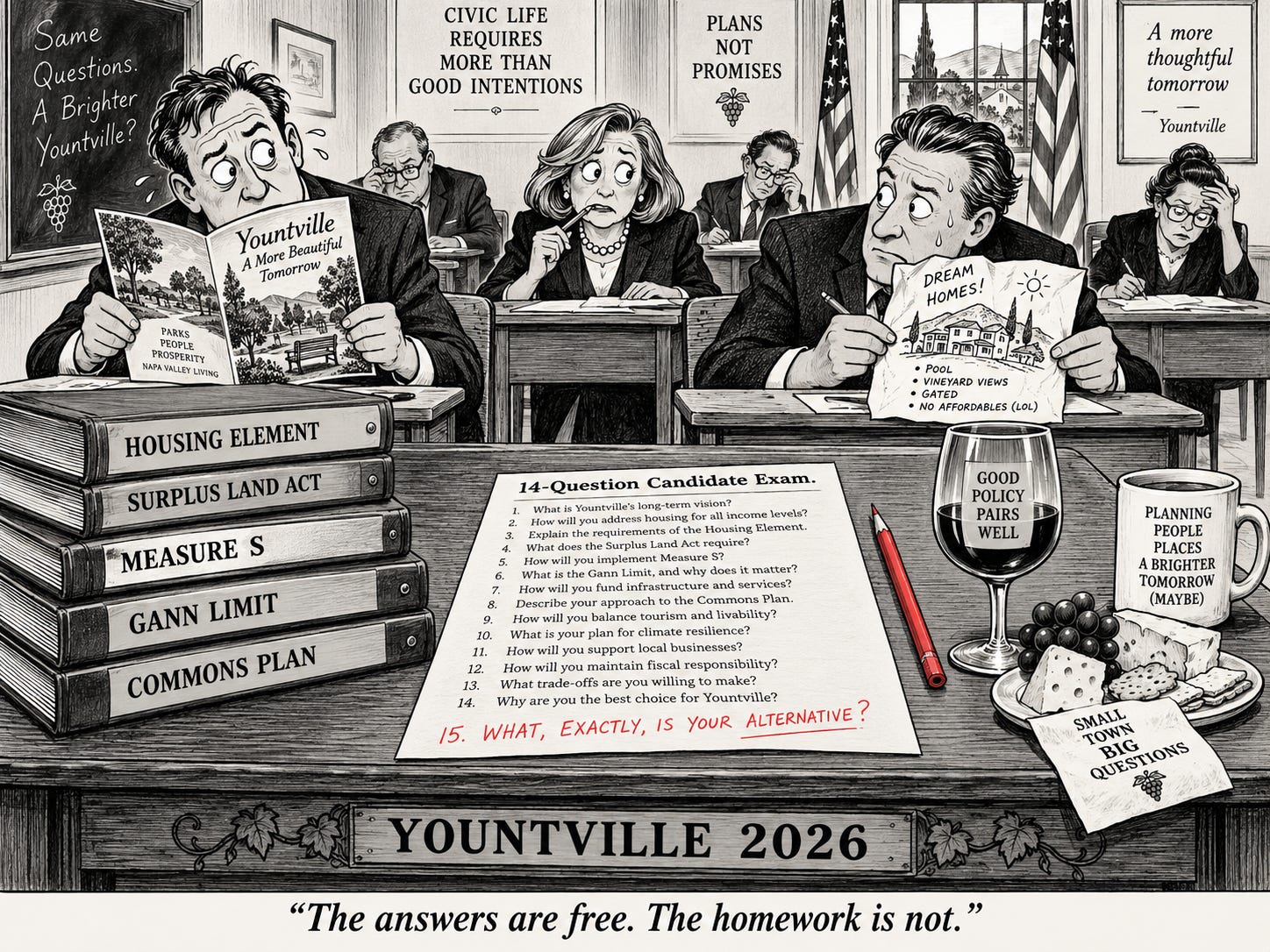
So after answering the Sun’s fourteen questions, the essay adds a fifteenth: What, exactly, is your alternative? If the Commons is too large, too expensive or simply wrong, then the competing ideas should now face the same test the Commons has faced for two years: draw them, price them, count the homes, explain the law, identify the funding and tell the public what happens next.
The answers are free. The homework is not.
The response to yesterday’s essay, The Sun Keeps Shining in One Direction, produced a question I should have expected: Fine. If I think the Sun’s questionnaire begins with some loaded assumptions and leaves some important subjects untouched, how would I answer it?
So here goes. I am not running for anything, and these are not endorsements of anyone who is. These are answers to the Sun’s actual questions, kept within the newspaper’s actual word limits so candidates are welcome to use them, change them, argue with them or check every fact themselves. In fact, I hope they do. The purpose is not to produce fourteen officially correct political opinions. It is to show what the answers look like when we remember why the Commons was proposed, what actually happened when the zoning was repealed, and what governing the property will require after the campaign signs come down.
One fact needs to be established before we begin because it affects almost every answer. The Town Council did not throw the Commons into a dumpster when it repealed the zoning ordinance. After the referendum petition qualified, the Council chose repeal rather than put the ordinance into an immediate winner-take-all election. The property returned to its previous zoning framework, while the Town retained the land, the Conceptual Site Plan, two years of public work and the underlying housing problem. The Town’s own history describes the Commons as a continuing long-term community planning effort and says that repeal returned the site to its previous land-use and zoning framework.
Question 1
Why are you running for office, and what are the three most important issues Yountville must address during the next four years?
150-word limit
I would focus on three things: housing, stewardship of public assets and restoring confidence in local government. Yountville has a certified Housing Element, Measure S revenues dedicated to affordable and workforce housing, and seven centrally located acres the Town deliberately purchased so the community could control their future. Those are assets, not problems. The next Council’s job is to turn them into measurable results while preserving the quality that makes Yountville worth protecting. That requires more than opposing what the last Council attempted. It requires understanding California housing law, municipal finance and the difference between listening to criticism and surrendering the responsibility to govern. Yountville does not need a revolution. It needs competent people willing to finish difficult public work.
Question 2
The Town purchased the former Yountville Elementary School property for approximately $11 million in 2024. What do you believe should happen next with the property?
200-word limit
Continue the Commons work, but use the zoning repeal for what it actually created: room to reconsider and explain. The Council did not sell the property, abandon the Conceptual Site Plan or erase two years of community planning. After the referendum petition qualified, it chose repeal rather than turn one zoning ordinance into a winner-take-all election. That returned the site to its previous zoning framework and gave the Town another opportunity to improve the plan. I would make phasing unmistakable, separate the first buildable increment from ultimate buildout, revisit assumptions that deserve another look, and preserve the parts that remain sound: public ownership, excellent design, community uses, open space and workforce housing. Starting from zero would waste the very public investment critics say they want protected. The responsible path is to build on what Yountville has already learned.
That is not a charitable interpretation of the repeal; it is what the official chronology shows. The Conceptual Site Plan was adopted in March 2025 as the long-term vision. Zoning and implementation tools followed. When the petition qualified in 2026, the Council repealed Ordinance 26-539 and returned the property to its previous zoning framework. The sequence matters because “repealed the zoning” and “abandoned the Commons” are not remotely the same thing.
Question 3
What type of housing, approximately how many units, for whom and at what level of affordability do you foresee at the Commons? What other uses should remain or be added?
200-word limit
The site should include permanently protected workforce and middle-income housing, with particular emphasis on studios and one-bedroom homes for individual workers, younger residents, seniors and modest-income households who have almost no chance in Yountville’s market-rate housing economy. I would not turn the final unit count into an ideological test. The sensible approach is phased construction: build an initial increment the Town can responsibly finance, learn from actual demand and operations, then decide how later phases should change. The existing garden, Yountville Fit, Locals Lounge, Farmstand, dog park, walking paths and public landscape should remain integral to the plan. Seven acres can do several civic jobs at once. The question is not whether the property should be housing or public space; it is how intelligently those uses can coexist.
Question 4
What public process should occur before the Commons moves forward? Should residents ultimately vote on a future plan?
150-word limit
Continue the public process, but begin by acknowledging that a substantial process already occurred. The Commons went through dozens of meetings, workshops, surveys, open houses, advisory meetings, Planning Commission discussions and repeated Council hearings. The problem was not that nobody was invited; it was that too many residents did not understand the long-range plan, its phasing or what each approval actually authorized. The repeal gives the Town an opportunity to fix that. Show the first phase clearly, put its cost beside it, and explain what is fixed and what remains flexible. I would not automatically require a public vote on the final plan. Representative government exists because land use, infrastructure, financing and California housing law are too complicated to reduce routinely to yes-or-no ballots. Residents should shape the decision extensively; elected officials still have to make it.
The Town’s record documents workshops, surveys, open houses, advisory committee meetings, Planning Commission discussions and Council meetings throughout 2024 and 2025. The reasonable criticism is that the process did not communicate the eventual plan well enough to everyone, not that the process somehow never happened.
Question 5
Beyond the Commons, where and how should Yountville accommodate additional housing while preserving its personality and charm?
200-word limit
Yountville should preserve existing deed-restricted homes, encourage appropriate ADUs and infill, examine every realistic housing site and involve major employers where practical. But it should not squander the unusual advantage of owning the Commons. Public ownership gives Yountville control over architecture, landscape, phasing, affordability and civic uses in a way private development does not. Density should be judged by design quality and neighborhood impact, not treated as a moral category. “Character” also needs a broader definition. Roof pitches, setbacks and mature trees matter, but so do the people who live behind the front doors. A town can preserve every handsome façade while gradually excluding the workers, younger families and middle-income residents necessary for ordinary community life. Good planning should protect both the physical town and the community that inhabits it.
Question 6
Does Yountville currently have the right balance between tourism and residential quality of life?
200-word limit
Tourism has been extraordinarily good to Yountville. It funds public services, supports remarkable businesses and gives a town of this size resources most communities could only envy. The question is whether that prosperity continues to support a functioning residential community. Parking, traffic and noise matter, but so does the fact that much of the workforce serving this economy cannot afford to live here. Large hospitality businesses create jobs, and those jobs create housing demand. That does not make employers villains or make the Town responsible for housing every employee; it simply means workforce housing belongs in the same conversation as hotel expansion and restaurant success. When interests conflict, the Council should weigh measurable neighborhood impacts, economic benefits and long-term community consequences. The goal is not to choose tourism or residents. It is to keep one from hollowing out the other.
Question 7
What should Heather Abrams’ priorities be, and what should the relationship between the Town Council and town manager look like?
200-word limit
The Council should govern and the town manager should manage. Heather Abrams should lead the professional organization, stabilize staff, provide clear financial information, implement Council policy and make the next stage of Commons planning understandable. The Council should set policy, approve budgets, evaluate the manager and demand measurable results without individually directing departments or employees. The manager, in turn, should give the Council candid professional advice without substituting administrative preference for elected policy. Immediate priorities should include Housing Element implementation, a clear Commons work plan and financial reporting ordinary residents can understand. After a year of political drama, boring competence would be a substantial civic achievement. Residents should be able to tell who made a policy decision, who implemented it and who is accountable for the result.
Question 8
What would you change about public involvement and transparency? What information should be available without a Public Records Act request?
250-word limit
Major projects should have plain-English online dashboards showing approved budgets, spending to date, contracts, amendments, financing assumptions, schedules and the decisions still ahead. Residents should not need a Public Records Act request to reconstruct basic project history. But transparency also requires honesty about what already occurred. The Commons was not planned in secret; it went through years of public meetings and review. If that process failed to communicate the plan clearly, fix the communication rather than erase the record. I would also require proposed alternatives to meet the same transparency standard. If someone wants mostly parkland, show the cost and explain where the housing goes. If someone proposes selling the property, explain the Housing Element and Surplus Land Act implications. Transparency is not merely forcing Town Hall to defend itself. It is requiring every serious proposal to survive contact with the same facts.
Question 9
Measure Y would increase Yountville’s appropriations limit for four years without imposing a new tax. Do you support it?
200-word limit
Yes. Measure Y is routine municipal housekeeping, not a new tax and not authorization for the Commons. California’s constitutional Gann Limit restricts how much qualifying tax revenue a local government may appropriate, and voters may raise that limit for periods of up to four years. Yountville has used this mechanism before. What makes Measure Y unusually important this year is the temptation to turn an ordinary fiscal measure into a protest vote against the current Council. Defeating it would not recover money already spent or repeal any housing plan; it could constrain the Town’s ability to appropriate qualifying revenues it already receives and complicate future budgets. Residents can disagree about the Council and the Commons without confusing an unrelated spending-limit measure with either issue. The danger in Measure Y is not that it is extraordinary. It is that its very mundanity makes it easy to misunderstand.
The Town’s own impartial explanation is wonderfully dull, which is exactly the point. Measure Y creates no tax, increases no tax rate and concerns only the amount of qualifying revenue the Town may legally appropriate during a four-year period. Using a spending-limit measure to express anger about an unrelated project does not change the Commons decision; it simply leaves the next Council with a more constrained fiscal tool. Whatever residents ultimately decide, they should at least know which lever they are pulling.
Question 10
What principles should govern reserves, borrowing and major capital spending?
150-word limit
Yountville should maintain reserves sufficient for downturns, emergencies and foreseeable obligations, while recognizing that excessive caution can become its own form of waste when important public needs remain unmet. Borrowing can be appropriate when a long-lived public asset benefits residents over many years and dependable revenues can support repayment. Major capital projects should disclose lifecycle costs, financing alternatives and realistic downside scenarios, with independent analysis when assumptions are complex or disputed. This is also why phasing matters at the Commons: it allows the Town to limit exposure, learn from early construction and adjust later commitments. Voter approval should occur when legally required or when a truly exceptional decision warrants it, not as a substitute for representative government every time a capital project becomes controversial.
Question 11
How should residents know your decisions are being made in the public interest when conflicts of interest exist or appear to exist?
150-word limit
Disclose relevant interests, follow California conflict-of-interest law and recuse when the law requires it. In a town as small as Yountville, personal and professional relationships are unavoidable; secrecy and selective scrutiny are not. Residents should be able to understand relevant financial interests, campaign relationships and the reasoning behind public decisions. The same standard should apply beyond Town Hall. Developers, major property owners, campaign organizers, donors and people seeking substantial influence over public policy should expect legitimate questions about interests affected by those decisions. That includes local media when an owner is an active participant in the controversy being covered. Public trust does not require everyone to be free of relationships. It requires disclosure, consistent standards and enough transparency for residents to judge those relationships for themselves.
That is why the Sun’s ownership matters journalistically. Gary Jabara was already an active Commons critic, had filed a sweeping public-records request, and had hosted an invitation-only discussion of alternatives before purchasing the newspaper whose Commons coverage he later praised. None of those facts proves that he directs coverage. They do make visible editorial independence especially important.
Question 12
What responsibility do elected officials have to maintain civility, and where is the line between inappropriate conduct and legitimate dissent?
150-word limit
Elected officials have a special obligation to remain professional because they hold public power, but civility is not a rule imposed only on the five people behind the dais. Speakers and audiences have obligations too. Criticism can be sharp, angry and even unfair without becoming improper; threats, harassment, jeering and deliberate intimidation cross a different line. The Council should enforce decorum consistently so every resident can speak without being mocked by the room. Civility also includes factual responsibility. Prominent citizens with unusual access to the press should make a reasonable effort to know the public record before accusing officials of secrecy or exclusion. I would add a camera facing the audience during public comment. The current broadcasts scrutinize every expression at the dais while hiding much of the atmosphere in the chamber. A fuller public record might improve everyone’s manners.
There is a reason I would answer this one more sharply than the Sun probably expects. On February 17, French Laundry General Manager Michael Minnillo participated in the packed Commons study session representing the Thomas Keller Restaurant Group. The Sun reported that Minnillo said TKRG had never opposed workforce housing. Keller himself attended a portion of the same meeting.
Two weeks later Keller publicly complained that nobody had come to him and asked what he thought about the project. That takes some chutzpah. His own general manager had been participating directly in the Town’s housing process, representing his company at a major public meeting and discussing the problem with Town officials. I was in the room when Keller made his accusation and had every opportunity to stand up and call bullshit. I did not. My only, admittedly weak, excuse is that after decades of attending public hearings, I had never watched someone of Keller’s stature make an accusation so plainly at odds with a public record his own company had helped create. Moments like that were part of what convinced me Yountville needed another newspaper voice. Too much of what passed for “civility” had become one-sided: elected officials were expected to sit quietly and absorb accusations while prominent residents and business owners could make claims that deserved considerably more scrutiny.
The same standard belongs in the audience. Residents should be able to stand at the microphone and criticize either side without being snickered at, jeered at or visibly mocked by other residents. I watched too much of that behavior during the Commons hearings, and the Council should have stopped it. A Yountville public meeting is not junior high with better wine. The mayor should enforce decorum consistently, and the Town should add a camera showing the audience during public comment. The broadcasts currently record every expression on the Council’s faces while revealing much less about the atmosphere confronting them. Sunshine remains a useful disinfectant, even if some just came from a Pilates workout.
Question 13
If you believed a decision was in Yountville’s long-term interest but many residents opposed it, whose judgment would you follow?
150-word limit
I would listen carefully enough to change my mind when the evidence warrants it, then exercise the judgment I was elected to use. The Commons zoning repeal is a good example. A referendum petition qualified, demonstrating opposition and creating a legal consequence. The Council responded by repealing the implementing ordinance rather than forcing an immediate election. That slowed the process and reopened discussion without erasing the Town’s ownership, planning work or housing obligations. Representative government requires both responsiveness and judgment. A councilmember who never changes course is not listening; one who simply follows whichever group is loudest is not governing. The obligation is to understand the breadth of public opinion, weigh the evidence and legal responsibilities, explain the decision clearly and accept political accountability for it.
This may be the current Council’s least appreciated decision. It had a legal route to put the ordinance before voters and fight the issue out through an election. Instead, four councilmembers chose the course that gave the community more time and made another conversation possible. In a town endlessly lectured about healing and listening, that act of restraint has received almost no credit at all.
Question 14
To incumbent candidates: What is one decision regarding the Commons and one regarding Brad Raulston’s departure that you would make differently today?
200-word limit
Only the incumbents can honestly answer what they would change about Brad Raulston’s departure because personnel matters and closed-session rules limit what outsiders know. On the Commons, however, the clearest lesson is communication. The Town should have explained phasing earlier, more simply and more often. The ultimate long-range buildout and cost estimate became confused with an immediate construction program, allowing critics to describe a flexible framework as though everything would be built at once. That communication failure had real political consequences. The later decision to repeal the zoning, however, deserves no apology. The Council could have forced the ordinance into a bitter election. Instead it backed up, restored the previous zoning framework and created room for additional discussion. In a town complaining about division, that was an act of restraint that deserves far more credit than it has received.
And Then There Is Question 15
The Sun did not ask this one, which is unfortunate because it may now be the most important question in the election: What, exactly, is your alternative?
For two years the Commons had the terrible disadvantage of becoming real. It developed drawings, unit counts, parking assumptions, infrastructure requirements, rents, financing models, public uses, phasing and costs. Every assumption therefore became visible enough to attack. The alternatives now circulating around Yountville have enjoyed a much easier existence. They remain cheaper, prettier and less controversial largely because imagination has no building department.
One suggestion is that the former school should become some version of Yountville’s Central Park. There is nothing wrong with wanting beautiful open space, and the Commons plan already preserves a great deal of it. But dedicating seven publicly owned acres primarily to parkland is a policy decision, not a watercolor. Yountville is aging, much of its workforce lives elsewhere, Measure S exists specifically for affordable and workforce housing, and the Town still has Housing Element responsibilities. Anyone proposing permanent parkland should therefore explain what public problem that solves and where the housing Yountville still needs would go instead. Nostalgia is a perfectly decent emotion, but it cannot by itself balance a Housing Element.
The other idea floating around is that Town facilities could be reorganized and the property eventually sold or converted to expensive private residences. Here California law intrudes rather inconveniently. Public land is not treated like a private parcel that can simply be listed with a broker. If a local agency decides to dispose of non-exempt surplus land, the Surplus Land Act generally requires the agency first to declare the land surplus, notify HCD, local public entities and affordable-housing developers, provide a mandatory response period and negotiate in good faith with qualifying housing proposals. HCD reviews the disposition process.
Most residents can be forgiven for never having heard of the Surplus Land Act; they have lives that do not require recreational reading of the California Government Code. Candidates asking to control seven acres of valuable public land have less excuse. They may soon be deciding whether Yountville retains this land, develops it, declares it surplus or attempts to dispose of it. Understanding the laws governing those choices seems like a fairly modest qualification for the job.
This is also one of the Sun’s great missed opportunities. Instead of asking candidates primarily how they feel about what the current Council did, the questionnaire could have tested whether they understand what the next Council can legally do. Have you read the Housing Element? Do you understand the Surplus Land Act? If you want fewer homes at the Commons, where do the remaining housing needs go? If you want to sell the land, what happens before a luxury developer ever gets near it? Those questions would tell voters who has actually done the homework required to govern.
The Sun could still write that story. An explanation of the Surplus Land Act and its implications for the Commons might contribute more to the election than another account of Gary Jabara’s latest complimentary wine-and-cheese gathering for Veterans Home residents. The social events may photograph better, but the statutes are what the next Council will actually have to live with.
None of this means the Commons plan should be preserved in amber. Perhaps there should be fewer homes. Perhaps the unit mix should change. Perhaps the first phase will teach the Town something important enough to change the second. That was always the point of creating a project that could be phased. But any alternative should now be subjected to the same treatment the Commons has endured for two years: draw it, price it, count the homes, identify whom they serve, explain the legal path, show what happens to Measure S and the Housing Element, and tell residents when someone actually gets a key.
That is the opportunity the Council created when it repealed the zoning instead of forcing an immediate election. It did not end the Commons; it gave Yountville time to understand the plan better, reconsider what deserves reconsideration and improve it where improvement is warranted. If the people who demanded that time have better ideas, they should be welcomed to the table and expected to bring them. But from this point forward, criticism alone is not a plan. Bring the drawings, the numbers, the legal analysis and a credible explanation of what happens next. The wine and cheese can stay at home. So can the chef’s whites.